What is coal as a sea-borne cargo?
Coal is a sedimentary fuel cargo carried in dry bulk under the IMSBC Code COAL schedule. It ships as thermal grades for power generation and metallurgical grades for steelmaking, classified Group B for self-heating, methane emission and oxygen depletion.
Sea-borne coal trade sits inside the 1.2 to 1.3 billion tonne range on most recent UNCTAD and Clarksons trade-flow estimates, making it the second-largest dry bulk commodity by volume after iron ore. The market splits into thermal coal, burned in power stations, and metallurgical coal, coked into reducing agent for blast-furnace steel. The shipping problem is similar across both grades: coal is friable, dusty, low-value per tonne, and chemically active enough that the cargo can heat itself in the hold.
The regulatory anchor for sea carriage is the IMSBC Code 2024, schedule entry COAL. The schedule classifies coal as Group B, meaning it presents a chemical hazard rather than a liquefaction risk. Operationally that translates into three live concerns on every voyage: self-heating, methane release inside the hold, and corrosive sulphur breakdown of paint and steel. INTERCARGO’s Bulk Carrier Casualty Report and the COAL schedule’s own special precautions for coals emitting methane and self-heating coals are the canonical operational references for gas and temperature monitoring.
Coal cargo properties
| Property | Value | Unit / Reference |
|---|---|---|
| Stowage factor | 0.79 to 1.53 | m3/t, varies by grade and moisture (IMSBC Code 2024, COAL schedule) |
| IMSBC group | Group B | Chemical hazard, not liquefaction (IMSBC Code 2024) |
| IMSBC schedule entry | COAL | Single schedule covers thermal and metallurgical grades |
| Bulk density | 0.65 to 1.27 | t/m3, grade dependent (654 to 1,266 kg/m3, IMSBC COAL schedule) |
| Angle of repose | Not applicable | Not specified in the IMSBC COAL schedule |
| Transportable moisture limit | Not applicable | Group B, TML applies only to Group A cargoes |
| Hazard profile | Self-heating, methane, low-oxygen, sulphur | IMSBC Code COAL schedule, special precautions |
| Reference | IMSBC Code 2024 edition | International Maritime Solid Bulk Cargoes Code, IMO |
The COAL schedule is one of the most operationally demanding entries in the IMSBC Code because it lists multiple live hazards in parallel. Self-heating is the dominant concern on long-haul voyages from Indonesia, Australia or Colombia, and it drives the requirement for hold temperature monitoring and surface levelling at the load port. Methane emission is the dominant concern at the load port itself and during voyage stoppages, when the cargo is undisturbed and methane can accumulate in the headspace. Sulphur is a slower-burn issue that shows up as paint damage and accelerated corrosion to tank-top and hopper coatings, and feeds into the longer-term maintenance bill on a coal-heavy vessel.
Vessel typing and parcel sizes
| Vessel class | Suitability | Typical parcel size | Notes |
|---|---|---|---|
| Capesize | Dominant | 150,000 to 180,000 t | Indonesia, Australia and Colombia long-haul to North Asia and Europe. Draught-limited at some load berths. |
| Panamax | Dominant | 65,000 to 82,000 t | Workhorse for thermal coal into India, China and Mediterranean. Hold cleanliness critical between grades. |
| Supramax | Common | 50,000 to 63,000 t | Indonesia to India, Russia East to North Asia. Gear-equipped for receivers without shore cranes. |
| Handysize | Conditional | 25,000 to 38,000 t | Niche lanes, smaller power plants, coastal redistribution. Higher freight per tonne. |
Coal parcel-size economics are driven by the cost of freight per delivered tonne and by the discharge port’s draught and crane fit. Long-haul Atlantic and Pacific exports to large receiving ports default to Capesize because the freight saving per tonne over a Panamax is material on a 10,000 nautical mile voyage. Shorter intra-Asia lanes, especially Indonesia to India and Indonesia to South China, run heavily on geared Supramax and Panamax tonnage because the receiving terminals are shallower and the parcel sizes do not justify Capesize. The Russia-East to North Asia lane sits squarely in the Panamax and Supramax range, with seasonal ice routing into Pacific Russian ports adding a winter premium.
Hold cleanliness is the single most under-priced operational issue in the coal trade. A vessel that lifted coking coal on the previous voyage and is then nominated for grain or alumina will fail hold inspection on residual coal dust unless the master books a full hold wash with hot water and chemical detergent at the discharge port. This is why coal-heavy fleets often run two or three coal voyages in series before resetting to a clean cargo.
How coal ships in practice
Coal loads predominantly by shore conveyor at dedicated coal terminals. Loading rates run from 20,000 t per day at smaller Indonesian transshipment anchorages, where coal is barged from upriver mines and loaded by floating crane or grab, to 80,000 t per day or higher at modern Australian, Colombian and Richards Bay terminals. The master’s loading plan must respect the IMSBC schedule’s surface levelling requirement: coal is trimmed flat across the hold to reduce surface area exposed to self-heating and to prevent shift in heavy weather.
Voyage care turns on three measurements taken daily: hold headspace temperature, methane concentration, and oxygen concentration. The IMSBC COAL schedule prescribes continuous monitoring on voyages over a defined duration, and most loadport surveyors will refuse the certificate of readiness if portable detection kit is missing or out of calibration. Hatch covers are kept closed and surface-sealed for the duration of the voyage. Ventilation is generally not permitted except under specific circumstances defined in the schedule, because admitting oxygen can accelerate self-heating.
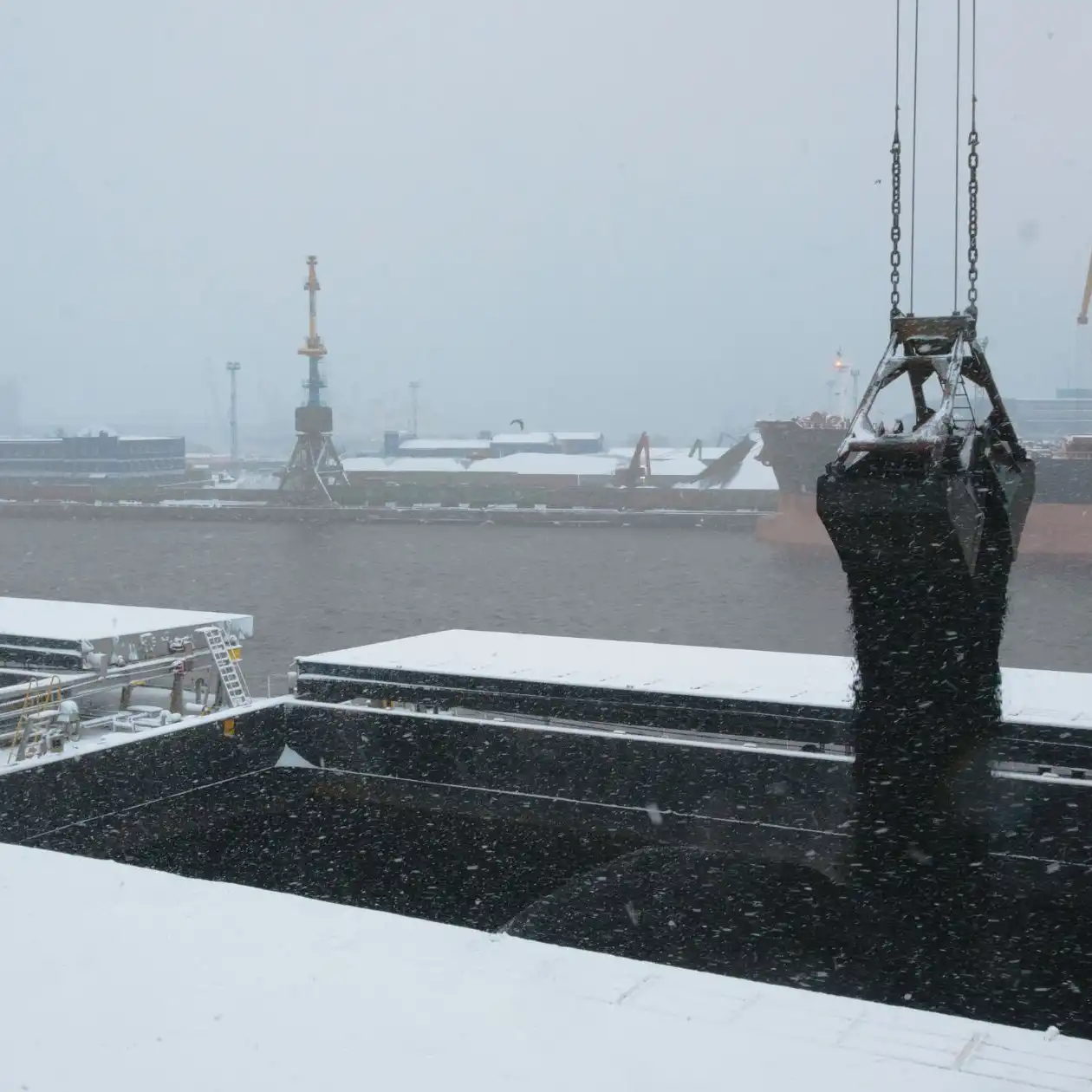
Discharge is by grab and shore crane at most Asian receiving terminals, by self-unloader at some Atlantic and Great Lakes ports, and by clamshell from floating cranes at transshipment anchorages. The dominant lane structure is one parcel per vessel: coal does not part-load with other cargoes because of the cleaning cost and the cross-contamination risk. The fixture is almost always on FIO terms with laytime and demurrage negotiated against the receiving terminal’s published norm. See loading and discharge rate for the contractual mechanics.
Major trade routes
- Indonesia to India: ~150 to 180 M t/yr of thermal coal, Supramax and Panamax dominant, monsoon-season barging delays at upriver Indonesian loadports.
- Indonesia to China: ~120 to 150 M t/yr, mix of Panamax and Capesize, sensitive to Chinese import policy windows.
- Australia to North Asia: ~200 M t/yr combined to China, Japan, Korea and Taiwan, Capesize-dominant, includes both thermal Newcastle grades and Queensland coking grades.
- Russia East to North Asia: ~80 to 100 M t/yr from Vostochny, Vanino and Wakhrushev, Panamax and Supramax dominant, winter ice routing premium.
- Colombia and US East Coast to Europe and Mediterranean: ~50 to 70 M t/yr, Panamax and Capesize, structurally declining as European thermal demand winds down.
- South Africa Richards Bay to India and Southeast Asia: ~50 to 60 M t/yr, Capesize-dominant, swung from Europe to Asia destination mix post-2022.
The intra-Asia thermal market is the volumetric core, with Indonesia and Australia loading roughly two thirds of all sea-borne coal between them. The Atlantic basin is in structural decline as European utilities decarbonise, with the surplus US, Colombian and South African tonnage redirecting east. For the wider lane catalogue across dry bulk see the dry-bulk-shipping hub.
Coal vs pet coke
Coal and petroleum coke are both Group B fuel-derived cargoes that ship on similar vessel classes into similar receivers, and the two are routinely confused at the cargo-order stage. They are not interchangeable.
| Coal | Pet coke (uncalcined) | |
|---|---|---|
| IMSBC group | Group B | Group B |
| Stowage factor | 0.79 to 1.53 m3/t | 1.25 to 1.67 m3/t |
| Bulk density | 0.65 to 1.27 t/m3 | 0.6 to 0.8 t/m3 |
| Dominant hazard | Self-heating, methane, oxygen depletion | Sulphur and dust emission, lower self-heating risk |
| IMSBC schedule | COAL | PETROLEUM COKE (uncalcined or calcined) |
| Typical end use | Power generation, blast-furnace coke | Cement kiln fuel, aluminium anodes, refinery fuel |
Use the COAL schedule when the commodity is mined from coal-bearing strata. Use the PETROLEUM COKE schedule when the commodity is a refinery residue from a delayed coker unit. The two grades carry very different sulphur profiles, dust behaviours and port-acceptance rules, and a fixture written against the wrong schedule will fail the loadport survey.
Reference example
Panamax thermal coal, East Kalimantan to East coast India
- Cargo grade
- 75,000 mt thermal coal, NAR 4,200 kcal/kg, 10 pct molo
- Lane
- East Kalimantan transshipment to East coast India
- Vessel band
- Modern Panamax, 76,000 dwt
- Parcel size
- 75,000 mt
- Loading rate
- 25,000 T/D SHINC, transshipment floating crane
- Discharge rate
- 20,000 T/D SHINC, grab and shore crane
- Notable clause
- COAL IMSBC monitoring kit clause, hold-temperature log countersigned by master, freight prepaid against original BL
The lane runs roughly 3,200 nautical miles one way. Loading at the East Kalimantan transshipment anchorage uses floating cranes that pick from feeder barges brought downriver from upcountry mines, which limits the rate compared with conveyor-loaded Newcastle or Richards Bay. Voyage time at economical speed is around eight days, well within the timeframe where self-heating becomes a documented concern under the IMSBC COAL schedule.
Hold preparation at the previous discharge port included a full sweep and freshwater rinse, with surveyor sign-off recorded before the laycan opened. The master’s daily voyage log captured headspace temperature, methane and oxygen readings at six-hourly intervals.
The fixture was on FIO terms with laytime calculated against weather working days SHINC at both ends. Demurrage was set close to the spot Panamax daily TCE for the month of fixture.
Common loading and discharge issues
- Methane accumulation during stoppages: the IMSBC COAL schedule’s special precautions for coals emitting methane set the monitoring regime, requiring methane to be kept below 10 pct of the lower explosive limit and the headspace measured at least daily. The risk is highest during port stoppages and during the first 48 hours after loading completes, when methane is still venting from freshly trimmed coal.
- Self-heating from poor surface trimming: oversized cones or unlevelled surfaces increase the air-exposed area and accelerate exothermic reaction. INTERCARGO casualty data shows surface trimming non-compliance as a recurring root cause on long-haul Indonesian and Australian voyages.
- Hold-temperature dispute at discharge: receivers occasionally claim cargo has been damaged by heating in transit and refuse to pay full freight or open a cargo claim. The master’s continuous temperature log, ideally with two redundant probe sets, is the evidentiary defence.
- Sulphur damage to tank-top and hopper coatings: cumulative over multiple voyages, this is a hidden cost that does not show up on a single fixture but compounds across a coal-heavy fleet’s drydock cycle.
- TML and moisture confusion with Group A cargoes: TML does not apply to coal, but loaders occasionally apply Group A documentation by mistake, causing certificate delays at the loadport. The correct schedule is COAL, Group B, with no TML certificate required.
- Dust emission complaints at discharge berths: a growing issue at Indian and Mediterranean ports with residential adjacency, occasionally driving discharge restrictions or fines that are passed back to the charterer under the cargo handling clause.
Scope and what this page does not cover
This page explains coal as a sea-borne dry bulk commodity, the IMSBC operational regime that governs its carriage, and the dominant vessel-class and lane structure. It does not forecast thermal or coking coal prices, opine on which load region to fix from in the next quarter, or interpret jurisdiction-specific cargo-claim case law on heating damage. For those, work with chartering counsel and a desk broker against current Baltic Exchange and Argus or IHS data. To fix a coal cargo, get a quote.