What is a Supramax bulk carrier?
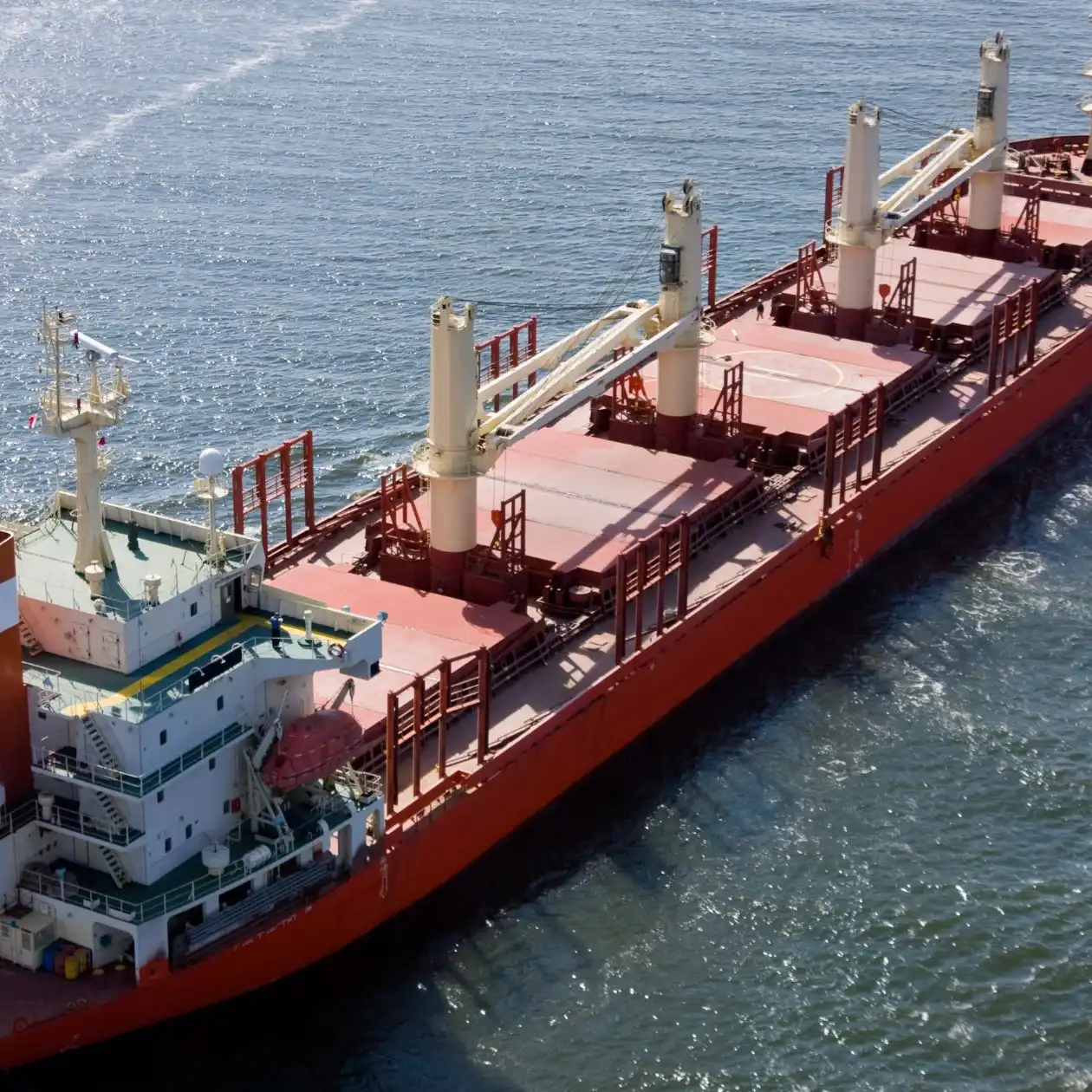
A Supramax is a geared bulk carrier of roughly 50,000 to 60,000 deadweight tonnes, named as the super Handymax tier, fitted with four deck cranes so it can work cargo at ports without shore gear. Ultramax variants push the upper end to 60,000 to 65,000 t.
The class sits in the middle of the geared bulk-carrier fleet, between the smaller Handysize and Handymax tonnage and the larger gearless Panamax. Lloyd’s Register class data and Clarksons fleet records register the Supramax as the dominant order-book volume in the mid-size geared segment, with the Ultramax sub-class (60,000 to 65,000 t, eco-design hull and engine, post-2010 builds) progressively replacing the older Supramax tonnage.
Owners and charterers reach for the Supramax when the trade calls for a geared vessel that can work a wide variety of cargoes at ports that lack shore cranes. The four-crane configuration with 30 to 35 t safe working load (SWL) per crane gives the class genuine port-independence. Operationally the Supramax is the workhorse of intra-Asia, ECSA grain export, US Gulf and Atlantic-basin grain, and NW Europe to West Africa lanes.
Supramax specifications
| Specification | Value | Source |
|---|---|---|
| DWT range (Supramax) | 50,000 to 60,000 t | Clarksons Supramax fleet data; Lloyd's Register class data |
| DWT range (Ultramax) | 60,000 to 65,000 t | Clarksons new-build orderbook (post-2010 eco-design) |
| LOA | 185 to 200 m | Clarksons fleet data, dominant Supramax builds |
| Beam | 31 to 32 m | Clarksons fleet data |
| Draught (summer) | 12.0 to 13.0 m | Lloyd's Register class data, load-line assignment |
| Holds | 5 | Standard Supramax/Ultramax design |
| Hatches | 5 | Standard Supramax/Ultramax design |
| Gear configuration | Geared, 4 x 30 to 35 t SWL cranes (Ultramax often 4 x 36 t) | Clarksons fleet data; major operator fleet specifications |
| Cubic capacity | approximately 70,000 m3 (grain) | Clarksons fleet data |
| Service speed (laden) | 13 to 14 kn | Clarksons fleet data |
| Service speed (ballast) | 13 to 14 kn | Clarksons fleet data |
| Typical cargoes | Grain, coal, fertilizer, bauxite, cement, steel products, sugar | Baltic Exchange S10TC route basket; major operator trade reports |
Sub-class boundaries within the Supramax family matter for newbuild selection and fixture matching. Standard Supramax is 50,000 to 58,000 DWT with 4 x 30 t cranes, typically built between 2005 and 2015. Ultramax is 60,000 to 65,000 DWT, eco-design hull and engine, often with 4 x 36 t cranes and grab buckets, and is the dominant newbuild tier post-2015. High-cube Supramax is a cubic-optimised variant for grain trades where the cube, not the deadweight, is the binding constraint. The Supramax to Ultramax boundary is gradually shifting as fleet replacement skews toward the larger Ultramax design.
Supramax vs adjacent classes
| Class | DWT band | Port accessibility | Dominant trades / lanes | Hire rate range (USD/day) |
|---|---|---|---|---|
| Supramax | 50,000 to 60,000 t | Most worldwide bulk ports, geared. Draught 12.0 to 12.5 m typical. | Intra-Asia coal, ECSA grain to SE Asia, US Gulf grain, NW Europe to W Africa | 11,000 to 16,000 (mid-cycle, S10TC) |
| Ultramax | 60,000 to 65,000 t | Same port reach as Supramax with marginal draught uplift. Geared 4 x 36 t. | Same as Supramax with eco-design fuel advantage on long haul | 12,000 to 17,000 (mid-cycle) |
| Handymax | 40,000 to 50,000 t | Smaller port reach than Supramax, fewer modern builds. Geared 4 x 25 to 30 t. | Smaller intra-Asia and regional lanes, second-hand market niche | 9,000 to 13,000 (mid-cycle) |
Selection between Supramax and Ultramax is largely a fuel-economics and parcel-size decision. Ultramax eco-design vessels with 4 x 36 t cranes carry roughly 5,000 to 10,000 t more cargo than a standard Supramax on the same draught, with materially lower fuel consumption on long haul. On time-charter, the Ultramax commands a premium of around 1,000 to 1,500 USD per day over the Supramax in mid-cycle markets. Owners with newer Ultramax tonnage win the long-haul grain and bauxite business. Owners with older Supramax tonnage compete on intra-regional, shorter-haul trades where the absolute hire rate matters more than fuel efficiency.
Selection between Supramax and Handymax is now largely about fleet vintage rather than design intent. Handymax tonnage is shrinking as fleet replacement skews to Supramax and Ultramax. Charterers fixing on the Baltic Supramax 10TC (S10TC) index almost always mean Supramax or Ultramax. Handymax appears in second-hand sale catalogues and on regional lanes where the older vessel still finds employment. See the Handymax and Handysize pages for the smaller geared classes, and Panamax for the gearless tier above.
Port accessibility and trade lanes
The Supramax is the most port-flexible class in the mid-size segment. Draught of 12.0 to 12.5 m and beam of 31 to 32 m clear most worldwide bulk berths. The four-crane geared configuration means the vessel does not depend on shore gear for loading or discharging.
- Intra-Asia coal lanes. Indonesian and Australian coal into China, India, Japan, South Korea, and Vietnam. Loading at East Kalimantan, Newcastle (Australia), and other Pacific basin terminals, discharging at Indian, Chinese, and SE Asian receivers. The Supramax is dominant on the smaller stems and on receivers without shore gear.
- ECSA to SE Asia grain. Soybeans and corn from Brazilian Atlantic ports (Santos, Paranagua, Rio Grande) and Argentinian Up-River loadings into Chinese and SE Asian receivers. The Supramax handles the medium-parcel grain trade alongside Panamax on the larger stems.
- US Gulf grain. Soybeans, corn, and DDGS from New Orleans area and Houston into European and Latin American receivers. The Supramax fits the secondary grain lanes outside the dominant Panamax flow.
- NW Europe to West Africa. Steel products, fertilizer, and project cargo from European ports (Rotterdam, Antwerp, Hamburg) into West African receivers (Lagos, Tema, Abidjan, Dakar). The geared configuration is essential at most West African discharge ports.
- Atlantic basin minerals. Bauxite from Guinea, manganese from South Africa and Gabon, and iron ore concentrates from Brazil into European and Asian receivers. The Supramax fits the smaller stems and receivers that lack Capesize berths.
- Intra-Mediterranean and Black Sea. Grain from Black Sea ports (Constanta, Yuzhny, Odesa) into Mediterranean and Atlantic basin receivers. Short-haul fertilizer, cement, and steel products inside the basin.
Draught flexibility of 11.5 to 12.5 m allows the Supramax to enter river ports (Up-River Parana, Mississippi to a limited reach), tidal terminals, and most receivers in West Africa, South Asia, and SE Asia. The class is one of the few that genuinely works port-independent on a global basis.
Typical cargoes and parcel sizes
The Supramax carries the widest diversity of dry-bulk cargoes in the fleet. Typical parcel sizes by cargo type, based on Clarksons fleet data and Baltic Exchange S10TC route basket:
- Grain (soybeans, corn, wheat): 50,000 to 58,000 t parcels. The largest single cargo group by volume on the class.
- Coal (thermal and metallurgical): 55,000 to 60,000 t parcels. Standard intra-Asia and Atlantic-basin parcels.
- Fertilizer (urea, DAP, potash): 40,000 to 55,000 t parcels. The Supramax is the Middle East to India workhorse for urea and DAP.
- Bauxite and alumina: 50,000 to 55,000 t parcels. Guinea to China and Atlantic-basin alumina lanes.
- Cement and clinker: 35,000 to 50,000 t parcels. Intra-regional and Asia to Africa lanes.
- Steel products (rebar, coils, plates): 30,000 to 50,000 t parcels. China to Middle East, China to West Africa, and intra-Mediterranean trades.
- Sugar (raw and refined): 35,000 to 55,000 t parcels. Brazil and Thailand origin trades.
- Iron-ore concentrates and pellets: 50,000 to 58,000 t parcels. Smaller Atlantic-basin and intra-Asia lanes outside the Capesize trade.
Many Supramax fixtures combine two cargo types in split parcels (for instance steel coils and bagged cement, or fertilizer and project cargo) where the four-crane gear and five-hold configuration support segregated stowage.
Vessel profile
The hull is medium-fine, with a raked stem and transom stern. Five box-shaped holds run the length of the cargo block, each served by a single hatch with steel folding or piggy-back hatch covers. Four deck cranes (30 t SWL on standard Supramax, 36 t on Ultramax) sit between the hatches, paired with grab buckets for self-discharge of grain, coal, and most ore cargoes. The deckhouse and accommodation block sit at the stern above the engine room.
Reference example
Representative Supramax workhorse, US Gulf grain
- Vessel name
- Representative Supramax, post-2010 build (composite, see flag)
- Operator type
- Mid-size Atlantic basin operator (Eagle Bulk, Star Bulk, Diana Shipping comparable)
- Year built
- 2011 to 2015 typical for standard Supramax tonnage
- DWT
- 56,000 to 58,000 t
- LOA
- 190 m
- Beam
- 32 m
- Draught (summer)
- 12.5 to 12.8 m
- Gear
- 4 x 30 t SWL cranes
- Typical trade
- US Gulf to Latin America grain; intra-Asia coal
The fixture above is a representative composite, not a named individual vessel. It reflects the post-2010 Supramax newbuild used by mid-size Atlantic-basin operators. The composite is flagged in desk-review for replacement with a named vessel and confirmed IMO if a specific recent fixture is available.
Common chartering considerations
- Geared port-independence is the selection driver. Charterers fixing into receivers without shore cranes (most of West Africa, large parts of SE Asia, intra-Caribbean) reach for the Supramax precisely because the vessel works cargo independent of shore gear. The premium over equivalent gearless tonnage is justified by the lane.
- Baltic Supramax 10TC (S10TC) is the benchmark index. The S10TC publishes a daily average of 10 representative time-charter routes. Charterers and owners reference the S10TC for time-charter equivalent (TCE) calculations and for index-linked fixtures. Ultramax has its own emerging Baltic index basket.
- Fuel consumption is around 22 to 25 t per day at service speed. Standard Supramax with conventional engine. Ultramax eco-design with electronically-controlled main engine consumes 18 to 22 t per day on the same route, which translates to roughly 800 to 1,500 USD per day fuel saving at present bunker prices.
- Fleet vintage matters at fixture. Vessels built post-2015 with electronically-controlled main engines, Tier II or Tier III NOx compliance, and ballast-water treatment system (BWTS) command a premium. Pre-2010 Supramax tonnage trades at a discount and is increasingly redirected to second-hand and demolition markets.
- Time-charter, voyage-charter, and trip-charter all common. See the time charter, voyage charter, and trip charter pages for the contract structures dominant in the class.
- Hold cleanliness varies by cargo. Grain trades demand food-grade hold standard with FOSFA or equivalent surveyor sign-off. Coal and ore trades demand only normal clean. Charter-party clauses on hold standard and surveyor scope are a frequent point of negotiation.
For the brokering-desk context on Supramax fixtures and chartering options, contact the ship brokering team, or get a quote with your parcel, lane and laycan to put a geared Supramax on the cargo.
Scope and what this page does not cover
This page is an operational and vessel-spec briefing on the Supramax class. It does not publish daily Baltic Supramax index levels, it does not forecast hire rates, and it does not offer broker-desk opinion on individual Supramax fixtures or newbuild orderbook decisions. Class-society and flag-state certification detail, regulatory compliance for individual vessels, and Memorandum of Agreement (MOA) terms for second-hand sales are outside the scope of this page. For commercial advice on Supramax employment or sale and purchase, see the bulk-carriers hub, the vessel specifications reference, and the size comparison page.