What is a Panamax bulk carrier?
A Panamax is a dry bulk carrier of roughly 60,000 to 80,000 DWT, dimensioned to transit the Panama Canal’s original locks at a maximum 32.31m beam. The name encodes the canal constraint. The class is the workhorse of coal, grain and secondary iron ore lanes.
By current hull count, Supramax/Ultramax is the largest dry-bulk segment (4,312 vessels), ahead of Panamax/Kamsarmax (3,472) and Handysize (3,202), per Breakwave Advisors’ Q3 2025 fleet composition data. Lloyd’s Register and DNV class registers carry the structural definitions, and Clarksons Research is the standard fleet-data source the desk reaches for when sizing positions. The original commercial constraint, the 32.31m beam of the Panama Canal’s old locks, dictated the breadth of the Panamax hull, and even after the 2016 lock expansion the bulk of the fleet built to that limit remains in trade. Around 2,600 to 3,000 mid-band units are in service per recent fleet counts, depending on where the Panamax and Kamsarmax bands are cut.
Inside the Panamax label sit several sub-classes the chartering market treats as distinct: traditional Panamax, Kamsarmax, post-Panamax, and Neopanamax. The 2016 canal expansion changed what “Panamax” means in practice. The new locks accept beam up to 51.25m (49m at the 2016 opening, raised in 2018) and LOA up to 366m, wider than any mainstream bulk carrier in service, so the canal is no longer the binding beam constraint for the modern mid-tier fleet. The traditional 32.31m beam nonetheless remains the defining commercial signature of the class.
Panamax specifications
| Specification | Value | Source |
|---|---|---|
| DWT range | 60,000 to 80,000 t (traditional Panamax) | Clarksons Research Panamax fleet data |
| LOA | 225 to 230 m | Lloyd's Register class data |
| Beam | 32.20 to 32.31 m | Panama Canal Authority old-lock width limit, original constraint |
| Draught at summer load line | 14.0 to 14.5 m | DNV class data, also bounded by US Gulf and several Asian terminals |
| Hold count | 7 | ABS structural standard for modern Panamax |
| Hatch count | 7 | Matches hold count, single hatch per hold |
| Gear configuration | Mixed; gearless and 4 x 30t deck cranes both common | Clarksons fleet data; roughly half the fleet geared |
| Cubic capacity | ~85,000 m3 | Grain cubic, Clarksons fleet average |
| Speed laden / ballast | 13 to 14 / 13 to 14.5 knots | Modern slow-steaming profile, Clarksons fleet data |
| Typical cargoes | Coal, grain, iron ore, bauxite, fertilizer, sugar, scrap | Clarksons trade-flow data |
Within the Panamax label the canonical sub-class boundaries run as follows. Traditional Panamax sits at 60,000 to 80,000 DWT with beam locked below the 32.31m old-lock limit. Kamsarmax tops out at roughly 82,000 DWT with LOA constrained to approximately 229m, dimensioned to fit the Kamsar bauxite terminal in Guinea. Post-Panamax sits at 82,000 to 85,000 DWT, free of the old-lock beam limit at around 36m beam, no longer canal-dimensioned and effectively a separate fixture market. New Panamax or Neopanamax describes vessels built to the post-2016 expanded locks (51.25m beam, 366m LOA, 15.2m fresh-water draught), but in dry bulk most Neopanamax-capable tonnage sits at the Newcastlemax and Capesize end of the fleet rather than the Panamax band.
Panamax vs adjacent classes
| Class | DWT band | Port accessibility | Dominant trades / lanes | Hire rate range (USD/day) |
|---|---|---|---|---|
| Panamax | 60,000 to 80,000 t | Panama Canal old-lock (32.31m beam); broad terminal coverage | Coal, grain, secondary iron ore, bauxite | 10,000 to 18,000 mid-cycle |
| Kamsarmax / Post-Panamax | 80,000 to 85,000 t | Kamsar Guinea (Kamsarmax LOA ~229m); post-Panamax exceeds old-lock beam | Bauxite, coal, grain | 11,000 to 19,000 mid-cycle |
| Supramax | 50,000 to 63,000 t | Broad: most general bulk terminals; gear-equipped | Coal, grain, fertilizer, steel, scrap, minor bulks | 9,000 to 15,000 mid-cycle |
Use a Panamax when the parcel is 60,000 to 78,000 t and the lane runs through ports with the terminal handling capability for the class, or through the Panama Canal itself. Coal stems from Newcastle to Japan, Richards Bay to India, and US East Coast to Europe sit in this band, as do US Gulf and Brazilian grain stems to Asia, Europe and the Middle East. The class is the structural default for coal and grain trades that do not justify Capesize lift.
Use a Kamsarmax or post-Panamax when the parcel runs to 80,000 to 85,000 t or when the lane includes Kamsar Guinea (Kamsarmax) or a receiver that cannot take the wider post-Panamax beam (constrains to traditional Panamax). Use a Supramax when the parcel is 50,000 to 63,000 t, the receiver is smaller, or the cargo requires geared discharge. The hire rate range above is a mid-cycle band rather than a specific Baltic Panamax 4TC print; the Panamax 4TC is the canonical period benchmark and the desk reads it continuously through the trading session.
Port accessibility and trade lanes
The Panamax lane structure is governed by two canal regimes (Panama and Suez), several restrictive river and channel depths, and a broad base of mid-tier terminals on both sides of each major dry bulk trade.
- Panama Canal old locks: 32.31m beam limit, 12.04m fresh-water draught, 294.13m LOA. Traditional Panamax sits inside these dimensions. Kamsarmax and post-Panamax tonnage exceeds the old-lock beam.
- Panama Canal new locks (post-2016): 51.25m beam (49m at the 2016 opening, raised in 2018), 15.2m fresh-water draught, 366m LOA. Accommodates any current bulk carrier including Newcastlemax and Capesize, so the canal is no longer the binding beam constraint for the modern mid-tier fleet.
- Suez Canal: governing draught and beam constraints do not bind at Panamax dimensions; the canal is a routing option on Atlantic to Asia and Black Sea lanes.
- US Gulf (New Orleans, Mississippi River): the Lower Mississippi Ship Channel controlling depth governs loading. The US Army Corps of Engineers deepened the channel to 50 ft (about 15.2m) by 2023, from the earlier 45 ft (about 13.7m). Even with the deeper channel, Panamax grain stems out of US Gulf commonly load to roughly 65,000 to 72,000 t because grain fills the holds by volume before the vessel reaches its deadweight, with any top-off taken at a Caribbean lighterage anchorage.
- Newcastle and Gladstone, Australia: large Panamax coal terminals. Restrictive for the tail-end of the Panamax band on tidal windows. The dedicated Newcastlemax class sits above.
- Kamsar, Guinea: bauxite export terminal that defines the Kamsarmax class. LOA limit ~229m, draught ~13.5m.
- Richards Bay, South Africa: thermal coal export terminal, Panamax and Capesize handling, broad draught capability.
- Indian receiving ports (Paradip, Krishnapatnam, Mundra): Panamax-dominant for thermal coal. Draught typically 14.0m to 14.5m, matching the Panamax summer load line.
The class’s terminal-coverage breadth is its structural advantage over Capesize. The bulk-carriers hub carries the broader vessel-class catalogue and the specifications and size-comparison aggregation pages.
Typical cargoes and parcel sizes
The Panamax’s cargo range is broader than any other mainstream bulk carrier class, and the parcel sizes track both the cargo’s stowage factor and the loading-terminal’s parcel norm.
- Coal: 60,000 to 78,000 t typical, both thermal (Newcastle to Japan and India, Richards Bay to India and Europe, US East Coast to Europe) and coking (Hampton Roads to North Asia, Australia to India and Europe). The largest single Panamax cargo by volume. See coal.
- Grain: 60,000 to 65,000 t typical, US Gulf to Asia and Europe, Brazil to Asia and Middle East, Argentina to North Africa and Asia, Black Sea to Mediterranean and Asia. Stowage factor of grain (around 1.30 to 1.50 m3/t for soybeans, higher for wheat) means Panamax holds fill on volume well before deadweight, which is why grain rarely fixes on Capesize. See grain.
- Iron ore: 75,000 to 80,000 t on the secondary lanes (West Africa to Middle East, India to Middle East, smaller Brazil to Mediterranean stems). Iron ore is so dense that Panamax loads to deadweight with holds half full by volume, which is the standard load picture on these lanes. See iron ore.
- Bauxite: 65,000 to 78,000 t typical on Guinea to refinery lanes that cannot take the full Capesize parcel, or on smaller West African and Caribbean trades. See bauxite.
- Fertilizer: 35,000 to 50,000 t typical, Russia and Morocco to Brazil and Asia. Often part-cargoes that combine with another commodity on the same fixture. See fertilizer.
- Sugar, scrap, cement: less common on Panamax, with sugar typically running on Supramax and scrap and cement spread across Supramax and Handysize. Panamax fixings on these cargoes are opportunistic. See cement.
The standard fixture forms for Panamax are voyage charter on coal and grain stems against the spot market, time charter for period business with operators running a routed programme, and spot charter against the Panamax 4TC. To fix a Panamax coal or grain stem, get a quote with the parcel, lane and laycan and the desk will work the position.
Vessel profile
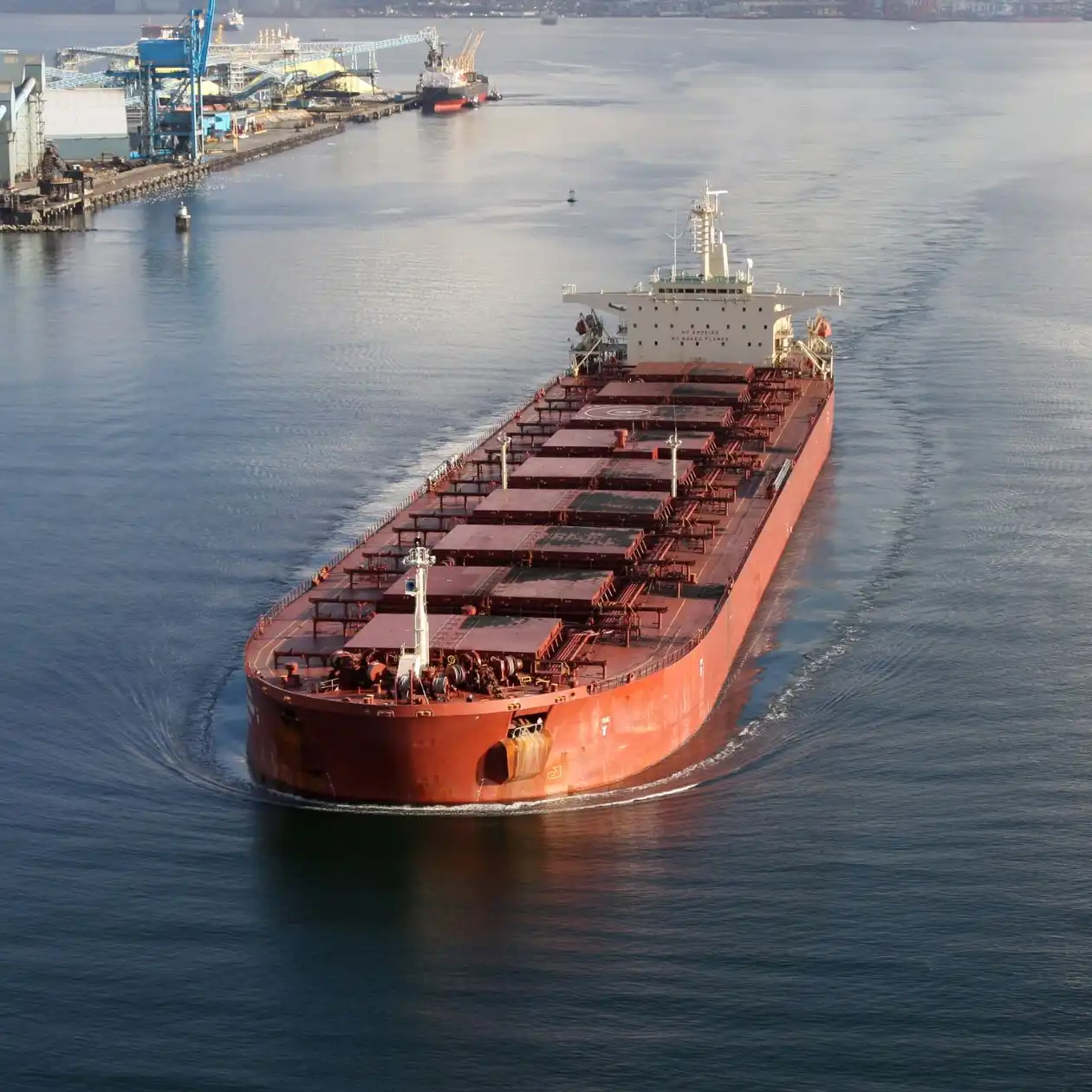
The structural identifiers of a Panamax are the long box-form hull with seven holds and seven hatches running fore-to-aft, the 32.26m beam locked to the old Panama Canal lock dimension, the mixed gear configuration (roughly half the fleet carries four 30t cranes, half is gearless), the single-island aft superstructure, the bulbous bow, and the transom stern. The 14m draught and the 32.31m beam together define the canal-compatible hull form. Geared Panamax tonnage handles its own discharge at terminals without shore cranes, which extends the lane structure into smaller receivers that gearless Panamax cannot serve economically.
Reference example
Representative modern Panamax, US Gulf to North Asia grain
- Vessel (composite)
- Modern 76,000 DWT Panamax, geared 4 x 30t cranes
- IMO
- Representative; specific IMO withheld pending verification
- Built
- 2015 to 2020 vintage
- DWT
- 76,000 t summer; about 65,000 to 72,000 t of grain loaded out of US Gulf (holds fill by volume)
- Dimensions
- LOA 229m, beam 32.26m, draught 14.2m summer
- Holds and hatches
- 7 / 7, four 30t deck cranes
- Typical trade
- US Gulf to North Asia grain, Newcastle to India thermal coal
This fixture template represents the mainstream modern Panamax that trades across coal, grain, iron ore and bauxite lanes. The modern fleet is dominated by Chinese, Japanese and Korean yards, with ownership concentrated in Pacific Basin, Star Bulk, NYK, Berge Bulk, Diana Shipping and the major Chinese state shipping groups.
On the US Gulf to North Asia grain lane the laden leg runs roughly 10,200 to 12,000 nautical miles one way depending on the discharge port, with Panama Canal transit on the laden leg and a comparable ballast leg back. Mississippi elevator loading runs at 1,500 to 3,000 t per hour, and a grain stem typically fills the holds by volume at roughly 65,000 to 72,000 t before reaching deadweight, with any top-off taken at the Caribbean lighterage anchorage.
Specific named-vessel examples (Pacific Basin Panamax fleet, Star Bulk Panamax tonnage, NYK Panamax fleet, Berge Bulk Kamsarmax tonnage) sit in this band.
Common chartering considerations
- Locking through the canal, old vs new: traditional Panamax tonnage transits the old locks; Kamsarmax and post-Panamax tonnage above 32.31m beam transits the new locks at higher booking cost. Canal slot booking and transit fees are a material line item in the voyage estimate and warrant explicit clause language in the fixture.
- Panamax 4TC index: the canonical period benchmark is the Baltic Panamax 4TC (a four-route time-charter equivalent). The Panamax 4TC print is the desk reference for both period fixtures and floating-rate exposure on COA structures. The Baltic Exchange publishes the index daily.
- Geared vs gearless: gear configuration changes the lane structure the vessel can serve economically. Geared Panamax tonnage commands a hire premium over gearless on lanes with smaller receivers and earns a discount on lanes with shore-crane handling, so the operator’s deployment plan should match the vessel’s gear configuration to the trade.
- EEXI and CII implications: the IMO EEXI and CII regulations, in force since 1 January 2023 (IMO resolutions MEPC.328(76) and MEPC.336(76)) with the first CII ratings issued in 2024, bite into older Panamax tonnage, particularly the pre-2010 fleet on coal and iron ore lanes. CII ratings of D and E force operational adjustments that interact with charter-party speed and consumption warranties.
- Coal phase-out and structural demand: the Panamax fleet’s largest single cargo, thermal coal, is structurally declining in OECD trade while growing in India and Southeast Asia.
Scope and what this page does not cover
This page describes the Panamax as a dry bulk vessel class, the canal-derived dimensional band that defines it, and the cargo and lane structure it serves. It does not forecast Panamax hire rates or 4TC prints, opine on sale-and-purchase decisions for specific vessels, or interpret jurisdiction-specific case law on Panamax casualties or charter-party disputes. For those, work with chartering counsel and a desk broker against current Baltic Exchange and Clarksons data.