What is a mini-bulker?
A mini-bulker, often called a coaster, is the smallest class of dry bulk carrier, typically running from about 1,000 to 15,000 DWT and occasionally up to around 20,000. The class sits one rung below Handysize at the bottom of the bulk-carrier size ladder, and it is built for a different job than the ocean-going classes above it. Where a Handysize or Supramax crosses oceans with a single large parcel, a mini-bulker works coastal and short-sea trades, moving smaller parcels between regional ports that the larger classes cannot reach.
The defining features of the class follow from that work. Mini-bulkers carry shallow draught, often only four to eight metres, so they can enter rivers, estuaries and small harbour basins. Most are geared, meaning they carry their own deck cranes or grabs and can load and discharge at wharves that have no shore handling equipment. They are short and narrow enough to navigate confined waterways and to fit berths sized for regional rather than deep-sea traffic. None of this is regulated by a single class definition. Like the larger bulk labels, mini-bulker and coaster are commercial and operational terms rather than IMO categories. What marks a vessel as a mini-bulker is that her deadweight, draught and self-sufficiency place her in the coastal and short-sea segment rather than the ocean fleet.
The economic case for the class is parcel size and port access. A great deal of dry bulk moves in lots far smaller than a Handysize can carry economically, between ports far too small for a larger ship to enter. Aggregates for a coastal construction project, grain from a river silo, fertilizer to a regional port, scrap to a small steel works: these cargoes suit a vessel sized to the job. The mini-bulker fills that gap across short-sea regions such as the Baltic, the North Sea, the Mediterranean and the rivers of inland Europe.
Mini-bulker specifications
| Specification | Value | Source |
|---|---|---|
| DWT range | 1,000 to 15,000 t (occasionally to ~20,000 t) | Clarksons Research short-sea fleet data |
| LOA | 60 to 130 m | Class register data, regional short-sea fleet average |
| Beam | 10 to 20 m | Class register data; constrained by river and lock dimensions on many trades |
| Draught at summer load line | 4 to 8 m | Class register data; shallow draught is the defining trait of the class |
| Hold count | 1 to 3 | |
| Hatch count | 1 to 3 | |
| Gear configuration | Often geared (deck cranes or grabs); some gearless | |
| Cubic capacity | ~2,000 to 20,000 m3 | |
| Speed laden / ballast | 9 to 12 / 10 to 13 knots | |
| Typical cargoes | Aggregates, grain, fertilizer, scrap, cement, salt |
The mini-bulker band is broad and shades into the classes around it at both ends. At the small end, vessels of one to three thousand DWT overlap with inland and river-only craft and with general coasters. At the large end, around fifteen thousand DWT and above, the class shades into the bottom of the Handysize range, and a few units of seventeen to twenty thousand DWT read as either depending on trade and configuration. Within the band the single most important variable is not deadweight but draught: a mini-bulker is chosen as much for the shallow water and small berths she can reach as for the tonnage she can lift.
Mini-bulker vs Handysize
| Class | DWT band | Draught and gear | Dominant trades / lanes | Typical parcel size |
|---|---|---|---|---|
| Mini-bulker | 1,000 to 15,000 t | Shallow (4 to 8 m); usually geared with own cranes | Coastal and short-sea: Baltic, North Sea, Mediterranean, river and estuary ports | 1,000 to 12,000 t |
| Handysize | 15,000 to 35,000 t | Moderate (~10 m); geared with own cranes | Regional and ocean trades; flexible across minor bulks and many ports | 15,000 to 30,000 t |
Use a mini-bulker when the parcel is small, the voyage is short, or the load or discharge port has draught, length or air-draught limits that exclude a larger vessel. The class is the natural fit for river and estuary ports, small coastal wharves and short regional legs where a Handysize would either run part-loaded or simply not fit. Self-discharging gear lets the mini-bulker work berths with no shore cranes, which is exactly the kind of port the class is built to serve.
Use a Handysize when the parcel is large enough to fill her, roughly fifteen thousand tonnes or more, and the ports on both ends can take her draught. The Handysize is the smallest of the mainstream ocean-going bulk classes, far more flexible across long-haul minor-bulk trades, and cheaper per tonne once the cargo and the ports justify her size. The bulk-carriers hub carries the full vessel-class catalogue, and the specifications and size-comparison pages set the mini-bulker against the rest of the fleet.
Port accessibility and trade lanes
The mini-bulker trade structure is the mirror image of the Capesize: instead of a handful of deep-water terminals, the class serves a very large number of small ports that larger vessels cannot reach.
- Baltic short-sea ports: a core mini-bulker region, moving grain, fertilizer, timber products, scrap and aggregates between small ports around the Baltic and into the North Sea. Ice-class tonnage is common.
- North Sea and continental river ports: ports up the Rhine, the Elbe, the Weser and the Thames estuary, and along the Dutch, Belgian, German and UK coasts, where shallow draught and modest length are the binding constraints.
- Mediterranean coastal ports: aggregates, cement, salt and grain moving between regional ports around the Mediterranean and the Black Sea, often at berths sized well below Handysize capability.
- Estuary and river terminals generally: silos, aggregate wharves, scrap yards and cement works sited on rivers and tidal creeks, reachable only by shallow-draught, self-geared tonnage.
Draught, overall length and sometimes air draught (clearance under bridges) are the binding constraints on whether a mini-bulker can reach a given berth, rather than the deep-water draught that governs the larger classes. Because the class is usually geared, the absence of shore cranes at a small port is not a barrier the way it would be for a gearless ship. Where a cargo grows beyond mini-bulker parcel size and both ports can take more draught, it moves up to Handysize or Supramax tonnage instead.
Typical cargoes and parcel sizes
Mini-bulker parcel economics are dominated by small lot sizes and short distances. The class earns its place carrying cargoes that do not fill a Handysize or that move between ports too small for one.
- Aggregates and sand: construction stone, gravel and sand for coastal and riverside building projects, often the highest-volume mini-bulker cargo in built-up short-sea regions.
- Grain: regional grain movements from river and coastal silos, parcels of a few thousand tonnes that suit a coaster rather than an ocean-going Handysize. See grain.
- Fertilizer: bagged and bulk fertilizer to and from regional ports, a steady short-sea cargo for the class. See fertilizer.
- Scrap metal: scrap to small and mid-sized steel works, frequently self-discharged with the vessel’s own grabs.
- Cement and clinker: cement, clinker and similar construction bulks between regional works and coastal markets.
- Salt: industrial and de-icing salt moving in small parcels around short-sea coasts.
The standard fixture forms for mini-bulker tonnage are the voyage charter for single regional cargoes and the time charter where a regional operator wants the vessel for a run of short-sea voyages. Ship brokering desks treat the short-sea and coaster segment as a distinct market from the deep-sea bulk classes, with its own regional brokers, tonnage lists and rate benchmarks. If you have a small parcel or a shallow-draught port that needs the right coaster, get a quote and the desk will size the tonnage to the cargo and the berth.
Vessel profile
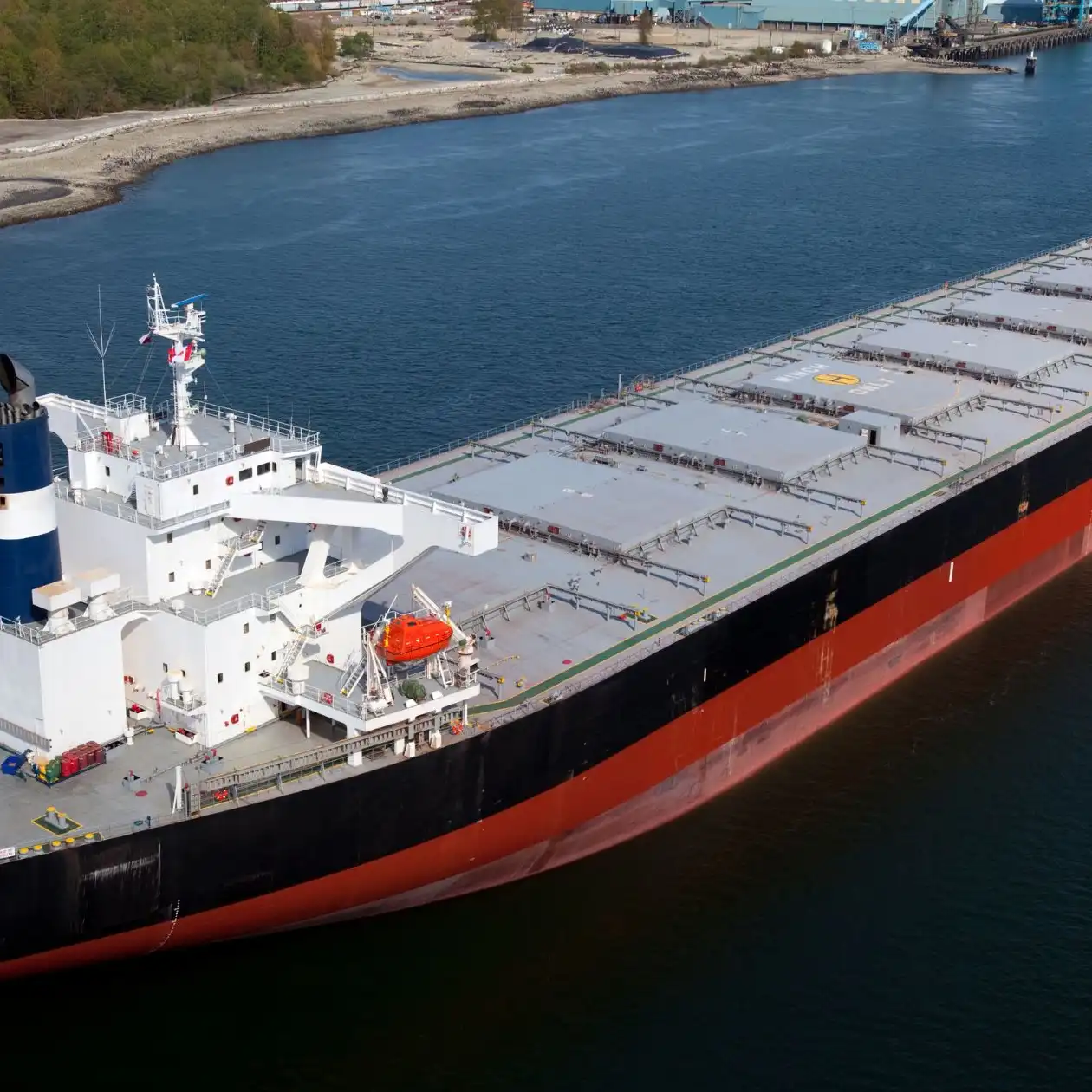
The structural identifiers of a mini-bulker are a short, shallow-draught hull, one to three holds (often a single large box hold for easy grab access), deck cranes or grabs in most units, a single-island aft superstructure and a compact overall length. The hull is shaped for confined waterways and small berths rather than for ocean crossings, so it trades the deep draught and large parcel of the ocean classes for the ability to enter rivers, estuaries and small harbours. The self-discharging gear, where fitted, is the feature that lets the class work ports with no shore cranes, which is most of the small ports the class is built to serve.
Reference example
Representative short-sea coaster, Baltic to North Sea cargo
- Vessel (composite)
- Modern geared mini-bulker, ~6,000 DWT
- IMO
- Representative; specific IMO withheld pending verification
- Built
- 2010 to 2020 vintage
- DWT
- ~6,000 t summer
- Dimensions
- LOA ~95m, beam ~14m, draught ~6m
- Holds and hatches
- 1 to 2, single box hold, geared with deck cranes
- Typical trade
- Baltic and North Sea short-sea aggregates, grain and fertilizer
This fixture template represents the workhorse short-sea coaster that lifts parcels of a few thousand tonnes between small Baltic and North Sea ports. The vessel is sized to enter river and estuary berths that an ocean-going Handysize cannot reach, and her own deck cranes let her load and discharge at wharves with no shore handling gear.
On a typical short-sea leg of a few hundred nautical miles, the coaster turns a voyage in days rather than the weeks an ocean class needs, so utilisation and port time dominate the economics far more than bunker burn on a long passage. Cargo handling with the vessel’s own grabs runs at modest rates suited to small-port throughput rather than the high shore-conveyor rates of the deep-water ore and coal terminals.
Specific named-vessel and IMO citations are left to desk verification against IHS Sea-web and the relevant owner or regional operator fleet pages before the page is moved to published status.
Common chartering considerations
- Parcel and port fit: the mini-bulker is chosen for the cargo and the port as much as for the tonnage. Draught, length and air-draught limits at the berth, and the small parcel size, are what put the cargo on a coaster rather than a Handysize.
- Self-discharging gear: because most small ports have no shore cranes, the vessel’s own deck cranes or grabs are central to the fixture. A geared coaster can work berths a gearless ship cannot, which widens the trades she can fix.
- Short voyages and high port time: short-sea legs mean port time, turnaround and waiting are a larger share of the economics than on ocean trades, where the long passage dominates. Operators watch utilisation and port congestion closely.
- Regional and seasonal markets: short-sea rates move on regional supply, demand and season (for example construction-aggregate demand and Baltic grain and ice seasons) rather than on the global Baltic indices that govern the deep-sea classes.
- Ice class and regional rules: in regions such as the Baltic, ice-class certification and local short-sea regulations bear on which tonnage can fix which trade and season, and feed into the charter-party terms.
Frequently asked questions
What is a mini-bulker?
How big is a mini-bulker compared to a Handysize?
Are mini-bulkers geared?
What cargoes do mini-bulkers carry?
What is a short-sea or coaster trade?
Why use a mini-bulker instead of a larger bulk carrier?
Scope and what this page does not cover
This page describes the mini-bulker and coaster as the smallest dry bulk vessel class, the dimensional band that defines it, and the cargo and lane structure it serves. It does not forecast short-sea freight rates, opine on sale-and-purchase decisions for specific vessels, or interpret region-specific short-sea or contract law. For those, work with chartering counsel and a regional short-sea broker against current market data.