What are aggregates as a sea-borne cargo?
Aggregates are construction minerals (sand, gravel and crushed stone) carried in dry bulk under several IMSBC Code schedules. Most are inert Group C cargoes that present a handling rather than a chemical hazard, though some fine wet sands fall under Group A and can liquefy.
The term aggregates covers the granular construction minerals that go into concrete, asphalt, road base and reclamation fill. The bulk of the sea-borne volume is crushed rock (limestone, granite, basalt), natural gravel, and sand. These are low-value, high-density, abrasive cargoes, which shapes almost every decision in how they ship. The cargo is cheap per tonne, so freight has to be kept low, which pushes the trade toward short distances and high-utilisation tonnage. The cargo is dense, so vessels load out by weight long before the holds are full. The cargo is hard and angular, so it wears down grabs, conveyors and hold steel faster than most other dry bulks.
The regulatory anchor for sea carriage is the IMSBC Code 2024, which classifies aggregates across multiple schedule entries rather than one. Inert crushed stone and clean gravel are typically Group C, meaning they neither liquefy nor present a chemical hazard. The important exception is fine, moist sand: some mineral and heavy sands are listed as Group A and can liquefy if loaded above their transportable moisture limit, so the cargo grade must be matched to the correct schedule before fixing. Treating all aggregate as inert Group C is an error that the loadport survey is meant to catch.
Aggregate cargo properties
| Property | Value | Unit / Reference |
|---|---|---|
| Stowage factor | 0.50 to 0.70 | m3/t, generalized band, varies by material and grading (IMSBC Code 2024). |
| IMSBC group | Group C (inert crushed stone, gravel); some fine sands Group A | Group C presents no chemical or liquefaction hazard; Group A sands can liquefy (IMSBC Code 2024) |
| IMSBC schedule entry | Multiple, e.g. CRUSHED STONE, GRAVEL, SAND | Match the schedule to the actual grade before fixing (IMSBC Code 2024) |
| Bulk density | 1.40 to 2.00 | t/m3, generalized band for crushed rock, gravel and sand (1,400 to 2,000 kg/m3). |
| Angle of repose | 30 to 45 degrees | Material dependent, higher for angular crushed rock than rounded gravel. |
| Abrasion and handling | Highly abrasive | Angular crushed rock wears grabs, conveyors and hold coatings; not a chemical hazard |
| Transportable moisture limit | Applies only to Group A sands | Inert Group C aggregate carries no TML; fine wet sands require TML certification (IMSBC Code 2024) |
| Reference | IMSBC Code 2024 edition | International Maritime Solid Bulk Cargoes Code, IMO |
The defining property of aggregate as a cargo is density, not chemistry. A hold loaded with crushed rock or wet gravel reaches its deadweight limit while there is still empty cubic space above the cargo, which is the opposite of a light, high-stowage cargo like wood pellets. That single fact drives the trade toward smaller vessels and shorter hauls, because the freight a low-value cargo can bear does not stretch to a long ocean passage. The second defining property is abrasion. Angular crushed stone scours grab buckets, conveyor belts and the hold’s tank-top and hopper coatings, so aggregate-heavy operators budget for faster wear than a grain or fertilizer trade would imply. The one chemical-style caveat sits with fine, moist sands: where the grade is a Group A sand rather than inert crushed stone, the liquefaction regime and a transportable moisture limit certificate apply just as they would for iron ore fines.
Vessel typing and parcel sizes
| Vessel class | Suitability | Typical parcel size | Notes |
|---|---|---|---|
| Handysize | Dominant | 10,000 to 38,000 t | Workhorse for short-sea and coastal aggregate. Geared, flexible at small construction ports. |
| Mini-bulker | Dominant | 2,000 to 9,000 t | Coastal and estuary trades, shallow construction wharves, river-sea movements. |
| Handymax | Common | 40,000 to 50,000 t | Longer regional and occasional deep-sea aggregate, where parcel size justifies the larger ship. |
| Supramax | Conditional | 50,000 to 63,000 t | Niche deep-sea aggregate to large reclamation or megaproject sites. Draught often the binding limit. |
Aggregate vessel typing is the inverse of the iron ore or coal trades. Because the cargo is cheap and dense, the economics reward short hauls on small, geared tonnage that can berth at minor construction ports and discharge with the ship’s own cranes. The bread and butter is handysize and mini-bulker tonnage moving sand, gravel and crushed stone a few hundred miles along a coast or across a narrow sea. Larger ships only enter the picture where a single megaproject (a port expansion, an airport platform, a land reclamation) generates enough demand to justify a deep-sea parcel. Even then, the high density means the ship loads to its marks on weight, so a supramax nominated for aggregate sails with cubic space to spare and draught, not volume, sets the parcel size.
Hold abrasion is the under-priced operational issue in the aggregate trade, in the same way hold cleanliness is for coal. Repeated loading and grab discharge of angular crushed stone wears tank-top and hopper coatings faster than a soft cargo, and the cumulative cost lands at drydock rather than on any single fixture. Operators who run aggregate in series tend to accept this and price it into the trade.
How aggregates ship in practice
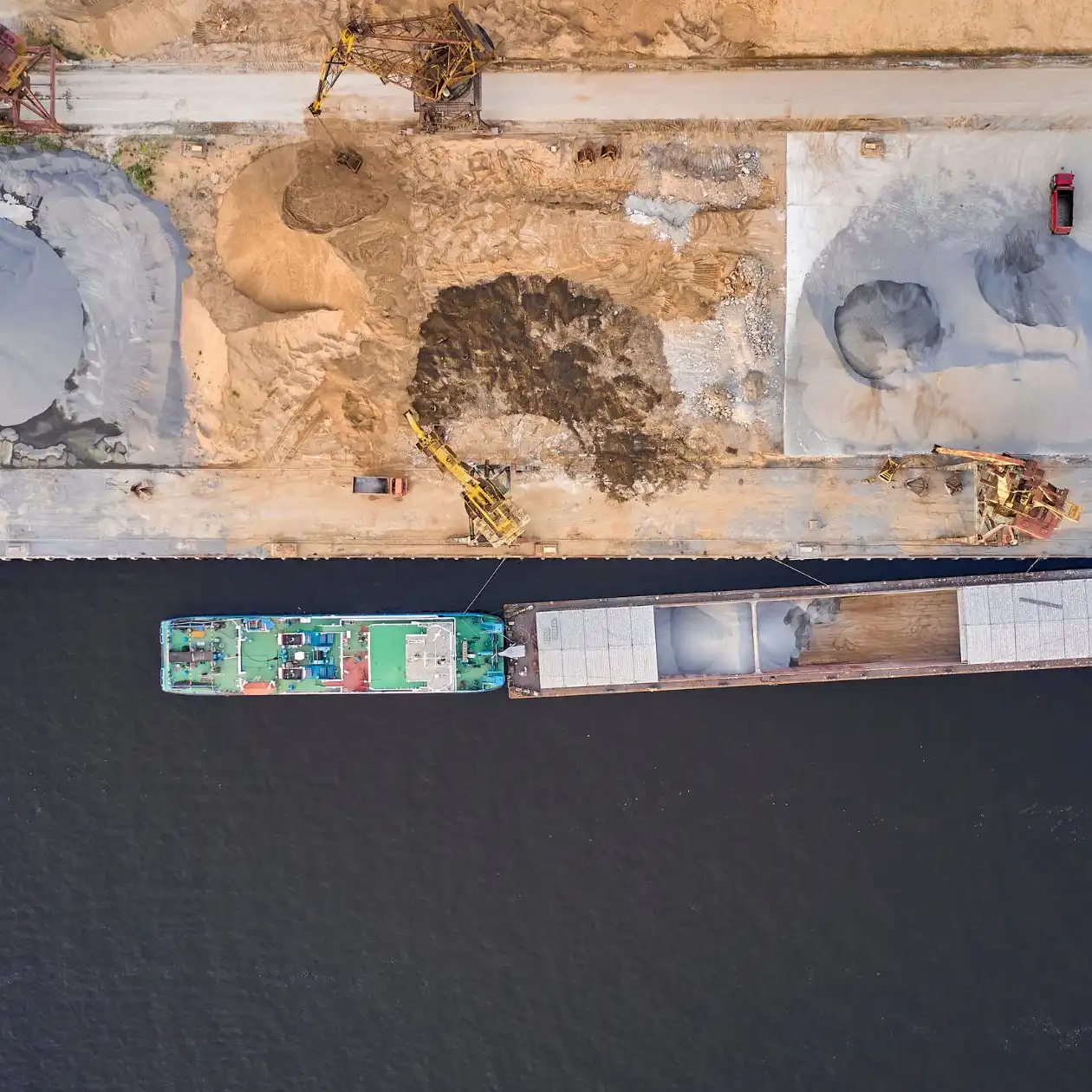
Aggregate loads predominantly by shore conveyor or front-end loader at quarry-adjacent wharves, and increasingly by dedicated high-rate conveyor at large export terminals. Loading rates vary widely with the facility: a small coastal quarry berth may load a few thousand tonnes a day by wheel loader and small grab, while a modern aggregate export terminal can run a fast conveyor at rates comparable to other dry bulk minerals. The cargo needs little special care on the inert Group C grades: it is trimmed for stability and stowed without the temperature, gas or moisture monitoring that govern reactive cargoes.
The exception is the moisture question on sand grades. Where the cargo is a fine, moist sand that falls under Group A, the loadport must certify the moisture content against the transportable moisture limit before loading, exactly as for iron ore fines. For inert crushed stone and clean gravel there is no such certificate, and the main loadport concern is simply trimming the cargo for a stable, well-distributed stow given its high density.
Discharge is by grab and shore crane at most receiving ports, by the ship’s own gear at smaller construction wharves, and by self-unloader at some dedicated aggregate terminals serving large urban markets. The dominant lane structure is one parcel per vessel on a short coastal or short-sea passage. The fixture is commonly on FIO terms with laytime and demurrage negotiated against the receiving wharf’s handling rate, and on these short hauls port time is a large share of the round voyage, so the loading and discharge rate is where the commercial value of the fixture is won or lost.
Major trade routes
- Short-sea Northwest Europe: a major short-sea aggregate flow, with sand, gravel and crushed rock moving between the UK, Ireland, the Low Countries, France and Scandinavia on handysize and mini-bulker tonnage. Marine-dredged sand and gravel from licensed seabed areas feeds coastal construction markets.
- Mediterranean coastal: crushed limestone and aggregate moving short distances between quarry coasts and construction-heavy receiving markets, mini-bulker and handysize dominant.
- Gulf and Middle East reclamation: aggregate and fill into large land-reclamation and megaproject sites, which is one of the few flows that can pull deeper-sea handymax and supramax parcels.
- Southeast Asia coastal and reclamation: sand and aggregate for reclamation and urban construction, a regionally significant flow with periodic export restrictions from source countries on environmental grounds.
- Intra-Asia construction minerals: crushed stone and gravel moving short and medium distances into fast-growing coastal construction markets, handysize-led.
The structural signature of the aggregate trade is that it is dominated by short-sea and coastal movement rather than the long deep-sea ocean lanes that define iron ore and coal. Demand tracks regional construction activity closely, so the trade is local, fragmented across many small lanes, and sensitive to where the building is happening. For the wider lane catalogue across dry bulk see the dry-bulk-shipping hub, and for regional context the routes and markets overview.
Aggregates vs iron ore
Aggregates and iron ore sit at opposite ends of the dry bulk spectrum despite both being mineral cargoes, and contrasting them is the clearest way to understand why aggregate ships the way it does.
| Aggregates (inert crushed stone / gravel) | Iron ore | |
|---|---|---|
| IMSBC group | Group C (some fine sands Group A) | Group A (iron ore fines) |
| Stowage factor | 0.50 to 0.70 m3/t (generalized) | 0.30 to 0.50 m3/t |
| Bulk density | 1.40 to 2.00 t/m3 (generalized) | 2.0 to 3.0 t/m3 |
| Dominant hazard | Abrasion and handling wear; liquefaction only on Group A sands | Liquefaction if moisture exceeds the transportable moisture limit |
| Vessel pattern | Handysize, mini-bulker, short-sea and coastal | Capesize and VLOC, long deep-sea |
| Typical haul | Short-sea and coastal, regional | Deep-sea, Brazil and Australia to North Asia |
Both are dense, low-value mineral cargoes, but the resemblance ends there. Iron ore is concentrated at a handful of giant export hubs and pulled in enormous parcels across the world’s longest dry bulk ocean lanes, which makes it a Capesize and Very Large Ore Carrier trade. Aggregate demand is spread across thousands of local construction markets, so it moves in small parcels over short distances on geared handysize and mini-bulker tonnage. The hazard profiles diverge too: iron ore fines are a Group A liquefaction cargo on every voyage, whereas inert aggregate is Group C and the liquefaction regime only bites on the specific Group A sand grades. The shared lesson is density: both cargoes load to deadweight long before the holds fill, but they answer that constraint with completely different fleets.
Reference example
Handysize crushed aggregate, short-sea coastal lane
- Cargo grade
- 28,000 mt crushed limestone aggregate, inert, IMSBC Group C
- Lane
- Quarry-adjacent export berth to coastal construction port, short-sea
- Vessel band
- Geared handysize, 32,000 dwt
- Parcel size
- 28,000 mt, weight-limited well before holds fill
- Loading rate
- 8,000 T/D SHINC, shore conveyor and front-end loader
- Discharge rate
- 6,000 T/D SHINC, grab and shore crane
- Notable clause
- FIO terms, hold-coating wear noted, aggregate stowage trimmed for stability given high density
The lane is a short-sea coastal passage of a few hundred nautical miles, typical of the aggregate trade. Because crushed limestone is dense, the ship loads to its marks on deadweight with cubic space still empty in the holds, so the parcel size is set by draught and weight rather than volume.
The cargo is an inert Group C grade, so it carries no transportable moisture limit certificate and needs no temperature, gas or moisture monitoring on passage. Hold preparation is straightforward, but the master notes accelerated wear to the tank-top and hopper coatings from the angular crushed rock, a cost that accumulates across an aggregate-heavy trading pattern.
The fixture is on FIO terms with laytime calculated against weather working days SHINC at both ends. On a short-sea lane like this, port time is a large fraction of the round voyage, so the loading and discharge rates and the demurrage exposure carry as much commercial weight as the freight rate itself.
Common loading and discharge issues
- Wrong IMSBC schedule for sand grades: treating a fine, moist sand as inert Group C when it is actually a Group A liquefaction cargo is an error. The grade must be matched to the correct schedule, and Group A sands need a transportable moisture limit certificate before loading under the IMSBC Code 2024.
- Abrasion to grabs, conveyors and hold coatings: angular crushed stone wears handling gear and tank-top and hopper coatings faster than soft cargoes. The cost is cumulative across voyages and lands at drydock rather than on any single fixture.
- Weight-limited loading and trim: high density means the ship reaches its deadweight marks with cubic space to spare, so the loading plan is about safe weight distribution and trim rather than filling the holds. Poor distribution can leave the ship stiff or unevenly stressed.
- Moisture migration in sand cargoes: where a Group A sand is carried, moisture above the transportable moisture limit can lead to liquefaction and a free-surface stability problem, the same hazard regime that governs iron ore fines.
- Dust at quarry and construction berths: crushed rock and dry aggregate generate dust on conveyor loading and grab discharge, which can drive handling restrictions at berths with residential or environmental sensitivity, passed back to the charterer under the cargo handling clause.
- Short-voyage port-time exposure: on coastal and short-sea aggregate lanes, port time dominates the round voyage, so any delay at the loading or discharge wharf converts quickly into demurrage. Negotiating a realistic handling rate against the wharf’s true capacity is critical.
Scope and what this page does not cover
This page explains construction aggregates (sand, gravel and crushed stone) as a sea-borne dry bulk cargo, the IMSBC schedules and density and abrasion properties that govern their carriage, and the short-sea, coastal and occasional deep-sea vessel and lane structure. It does not forecast aggregate or construction-material prices, opine on dredging licences or marine-mineral extraction policy, or interpret jurisdiction-specific rules on seabed sand and gravel rights. For those, work with chartering counsel and a desk broker against current market data, and confirm the exact IMSBC schedule for the specific grade with the loadport surveyor. To put an aggregate parcel in front of our desk, get a quote.