What is iron ore as a sea-borne cargo?
Iron ore is the highest-volume dry bulk cargo by tonnage, shipped from Brazil, Australia and West Africa to steelmakers in North Asia. Fine grades fall under IMSBC IRON ORE FINES Group A, with liquefaction risk governed by the transportable moisture limit.
Iron ore is the input to blast-furnace steelmaking and accounts for roughly 1.6 to 1.7 billion tonnes of annual sea-borne trade on most recent UNCTAD and Clarksons trade-flow estimates. The commodity ships in two physical forms that matter for sea carriage: lump or sinter feed in larger pieces, and fines (the dust and small-particle fraction that aggregates to roughly two thirds of global volume). The shipping problem is dominated by one issue: iron ore fines can liquefy in transit if moisture exceeds the transportable moisture limit, and the consequence of an undeclared TML breach is catastrophic loss of stability.
The regulatory anchor is the IMSBC Code 2024, schedule entry IRON ORE FINES, classified Group A. IMO MSC.1/Circ.1454 sets the guidance on Group A cargoes and the moisture certification regime, and INTERCARGO’s casualty annexes record the bulk-carrier losses that drove the schedule into the IMSBC Code in 2017. The COAL or grain operational regime does not apply: iron ore fines is a stability cargo first and a chemical cargo not at all.
Iron ore cargo properties
| Property | Value | Unit / Reference |
|---|---|---|
| Stowage factor | 0.30 to 0.50 | m3/t, varies by grade and lump content (IMSBC Code 2024, IRON ORE FINES schedule) |
| IMSBC group | Group A | Liquefaction risk if moisture exceeds TML |
| IMSBC schedule entry | IRON ORE FINES | Distinct from IRON ORE schedule which covers lump and sized fractions |
| Bulk density | 2.0 to 3.0 | t/m3, one of the densest commercial dry bulks |
| Angle of repose | Not applicable | Not specified in the IRON ORE FINES schedule (Group A flow-moisture cargo) |
| Transportable moisture limit | Per cargo certificate | Shipper-issued, typical band 8 to 12 pct depending on origin |
| Reference | IMSBC Code 2024 edition | International Maritime Solid Bulk Cargoes Code, IMO |
The IRON ORE FINES schedule is the canonical reference for fine grades and was added to the IMSBC Code after a cluster of casualties on the Indonesia and India lanes in the early 2010s. The dominant operational concern is liquefaction: when moisture exceeds the TML, vibration from the vessel’s engines and seaway can collapse the cargo into a fluid mass that shifts on the roll, and at scale this is sufficient to capsize a Capesize. The shipper’s responsibility is to issue a TML certificate and a moisture-content certificate before loading. The master’s responsibility is to refuse loading if the moisture content reported on the cargo certificate exceeds the TML, regardless of commercial pressure.
Vessel typing and parcel sizes
| Vessel class | Suitability | Typical parcel size | Notes |
|---|---|---|---|
| VLOC and Newcastlemax | Dominant on Brazil-China | 260,000 to 400,000 t | Vale Brazil-built fleet and Chinese-controlled VLOCs dominate the Tubarao to Qingdao lane. |
| Capesize | Dominant | 150,000 to 180,000 t | Workhorse of Australia-China and West Africa-China. Draught and crane fit at most major ore terminals. |
| Panamax | Common | 65,000 to 82,000 t | Smaller Asian receivers, Middle East and Mediterranean lanes. Higher freight per tonne. |
| Supramax | Conditional | 50,000 to 63,000 t | Niche short-haul, Indian coastal, smaller Vietnamese and Malaysian receivers. |
| Handysize | Rare | Below 38,000 t | Effectively absent from main iron ore trade. Freight uneconomic. |
Iron ore parcel-size economics are extreme because the cargo is so dense that vessel hold volume is never the binding constraint, but vessel deadweight and draught are. A Capesize with a stowage factor of 0.40 m3/t will load to deadweight long before the holds are physically full, which is why iron ore is one of the few cargoes that routinely fixes Newcastlemax and Valemax tonnage above the standard Capesize band. The VLOC class exists almost entirely because of this trade. On lanes where receiving terminals cannot take Capesize draught, the cargo down-tiers to Panamax or Supramax with a material freight-per-tonne penalty.
The dominant typing on Brazil to China is VLOC and Capesize, with the Vale-built Valemax fleet structured to lift the Tubarao or Ponta da Madeira to North China lane in single 400,000 t parcels. Australia to China runs predominantly on standard 180,000 t Capesize because the Western Australian terminals at Port Hedland and Dampier are sized for that class.
How iron ore ships in practice
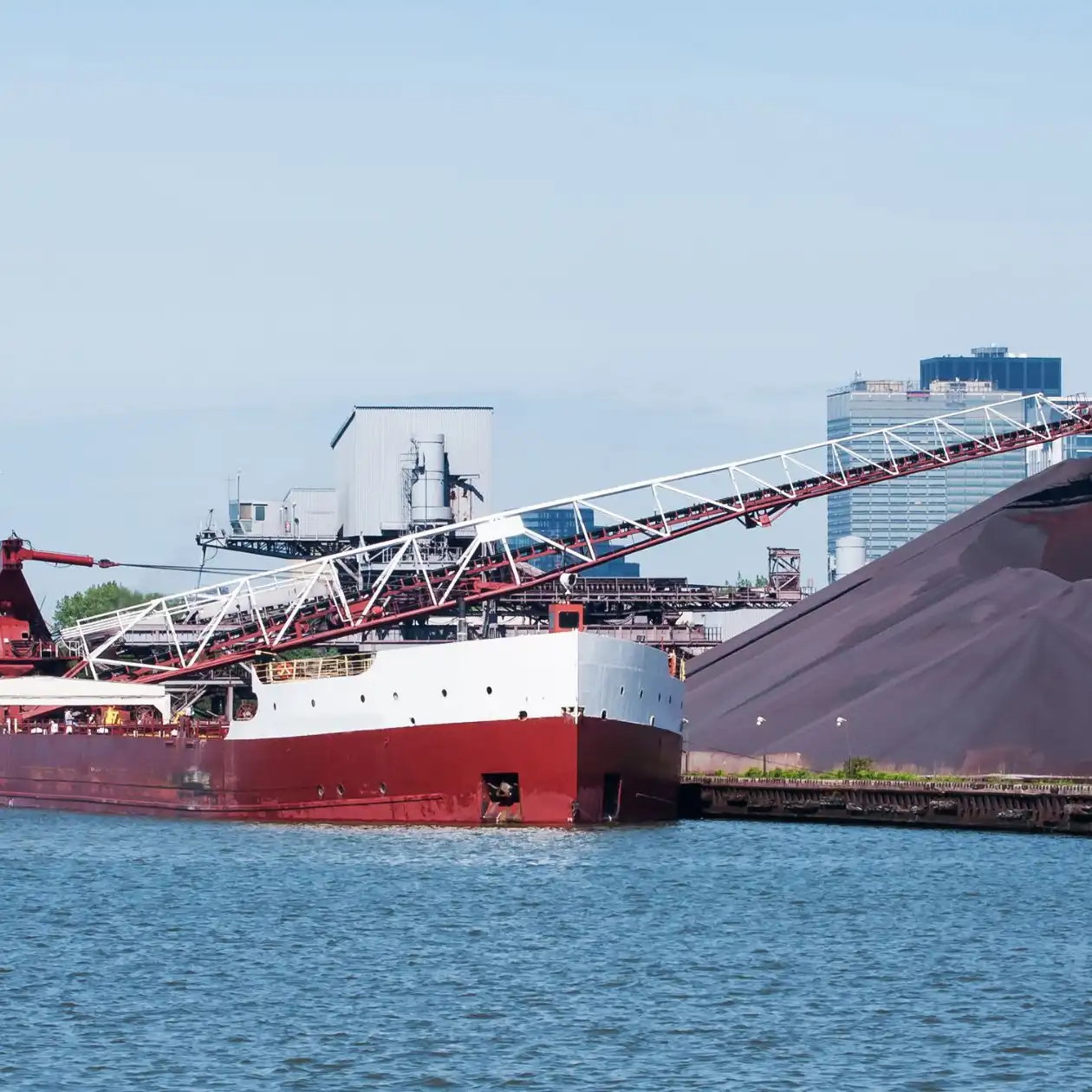
Iron ore loads by shore conveyor at dedicated ore terminals in Brazil (Tubarao, Ponta da Madeira), Australia (Port Hedland, Dampier, Cape Lambert), West Africa (Nouadhibou, Pepel, Conakry), South Africa (Saldanha Bay) and Canada (Sept-Iles). Loading rates run from 5,000 t per hour at older terminals to 15,000 t per hour at modern automated facilities. The full Capesize is loaded in 12 to 24 hours at the larger facilities, which keeps berth occupancy high and makes the laycan window tight.
The pre-loading documentation cycle is the central operational discipline. The shipper issues a TML certificate, a moisture certificate (often from a separate accredited laboratory), and a cargo declaration under IMSBC Section 4. The master verifies that moisture is below TML and that the declaration is internally consistent before tendering notice of readiness. If the documentation slips or the moisture sample exceeds TML, the master is entitled to refuse loading and the laytime clock is paused under most charter party forms. P and I clubs maintain published guidance on the can-test as a master’s backstop check, recognising that it is indicative rather than dispositive.
Voyage care for IRON ORE FINES is light compared with coal because there is no chemical activity to monitor. Hatch covers are kept closed and weather-tight. The vessel is fixed at trim and the stability calculation is verified against the loadport’s declared cargo density. Discharge is by grab and shore crane at most Asian receiving terminals, with high-throughput conveyor handling at the larger Chinese ports. The fixture is almost always on FIO terms with voyage charter being the dominant instrument, although contracts of affreightment cover the long-running Vale and BHP programmes.
Major trade routes
- Brazil to China: ~280 to 320 M t/yr from Tubarao and Ponta da Madeira to Qingdao, Caofeidian and Beilun, VLOC and Capesize dominant, voyage ~11,500 nm one way around Cape of Good Hope or Cape Horn.
- Australia to China: ~700 to 750 M t/yr from Port Hedland, Dampier and Cape Lambert to North Chinese receivers, Capesize-dominant, the single largest commodity lane in sea-borne dry bulk.
- Australia to Japan and Korea: ~200 M t/yr combined, Capesize and Newcastlemax, structurally stable on long-term contracts with integrated steelmakers.
- West Africa to China: ~30 to 50 M t/yr from Mauritania, Sierra Leone and Liberia, Capesize-dominant, with growth expected as Guinea’s Simandou mine ramps toward a 120 M t/yr target by 2027-28.
- South Africa Saldanha to China and Korea: ~50 to 60 M t/yr, Capesize, dedicated ore line from the Sishen mining complex.
- Canada Sept-Iles to Europe and Asia: ~20 to 30 M t/yr of high-grade pellet feed, Capesize-dominant.
The Brazil and Australia origins between them account for the overwhelming majority of sea-borne iron ore, and the dominant destination is Chinese steelmaking. Simandou shipped its first commercial cargo aboard the bulk carrier Winning Youth in December 2025, and the mine’s ramp-up toward that 120 M t/yr target is expected to meaningfully increase Capesize and VLOC tonne-mile demand, since the Guinea-China route runs roughly three times longer than the dominant Australia-China corridor, per Lloyd’s List and Drewry Maritime Research. The routes-markets hub carries the wider lane catalogue, and the dry-bulk-shipping hub covers the operational counterparts to iron ore at the stowage-factor and stowage-guide reference pages.
Iron ore vs bauxite
Iron ore fines and bauxite fines are both Group A liquefaction-risk cargoes, both Capesize-dominant on their long-haul lanes, and both shipped predominantly into the same North Asian receiver base. They are not the same cargo and the operational profile differs materially.
| Iron ore fines | Bauxite fines | |
|---|---|---|
| IMSBC group | Group A | Group A (BAUXITE FINES); Group C for non-fine grades |
| Stowage factor | 0.30 to 0.50 m3/t | 0.65 to 0.85 m3/t |
| Bulk density | 2.0 to 3.0 t/m3 | 1.2 to 1.5 t/m3 |
| Loading constraint | Deadweight-limited, almost never volume-limited | Often volume-limited on lower-density grades |
| TML certification regime | Mature, post-2010s casualty cluster | Newer, post-Bulk Jupiter 2015 schedule |
| Dominant lane | Australia-China and Brazil-China | Guinea-China and Australia-China |
Use iron ore fines when the commodity is destined for blast-furnace ironmaking. Use bauxite when it is destined for alumina refining and onward smelting to aluminium. The two TML regimes are governed by the same Group A rules in the IMSBC Code, but the post-Bulk Jupiter amendments specifically tightened the BAUXITE FINES schedule and added moisture-monitoring guidance distinct from the older IRON ORE FINES regime. A fixture written against the wrong schedule will not satisfy the loadport surveyor’s certification check.
Reference example
Capesize iron ore fines, Tubarao to North China
- Cargo grade
- 170,000 mt iron ore fines, ~63 pct Fe
- Lane
- Tubarao region to Qingdao-Beilun range
- Vessel band
- Modern Capesize, 180,000 dwt
- Parcel size
- 170,000 mt
- Loading rate
- 60,000 T/D SHINC, shore conveyor
- Discharge rate
- 40,000 T/D SHINC, grab and shore crane
- Notable clause
- TML certificate countersigned by independent surveyor, can-test reserved to master, freight prepaid against original BL
The lane runs roughly 11,500 nautical miles one way around Cape of Good Hope. At a stowage factor of around 0.40 m3/t the vessel loads to deadweight with holds approximately 75 pct full by volume, which is the standard load picture for a Brazil-China Capesize.
Pre-loading documentation included a TML certificate at 9.5 pct and a moisture certificate at 8.6 pct, both issued within five days of loading commencement, with the moisture certificate countersigned by an independent surveyor at the master’s request. The master’s can-test confirmed no free moisture migration at the sample point. The cargo declaration was filed under IMSBC Section 4 and cross-checked against the IRON ORE FINES schedule entry.
The fixture was on FIO terms with laytime calculated against weather working days SHINC at both ends and demurrage at the spot Capesize daily TCE benchmark. Freight was prepaid against original bill of lading, which is the standard ask on Brazil-China voyages with the longer ballast leg and bunker exposure.
Common loading and discharge issues
- TML certificate disputes: the post-2010s casualty cluster on the Indonesia and India lanes was driven by under-reported moisture content, and surveyors now routinely cross-check shipper-issued TML against an independent sample. Masters who refuse a loading on certificate inconsistency are supported by P and I club guidance and by the IMSBC Group A regime.
- Can-test ambiguity: the can-test is a master’s backstop, not a definitive measurement. The right operational stance is to use it as a trigger for a formal moisture re-sample rather than as a standalone refusal basis.
- Trim and stability error: iron ore is so dense that incorrect trim distribution can leave the vessel structurally stressed and unable to clear loadport draught surveys. The loading plan must match the stability booklet and be agreed in writing before loading commences.
- Tank-top damage from heavy density: cumulative wear on a vessel that runs an iron ore programme for years is one of the highest-impact items in the drydock cycle, and is often under-priced in fleet acquisition models.
- Hold cleanliness for the next cargo: residual iron ore stains and dust will fail a grain-clean inspection. Vessels switching from iron ore to grain or alumina require a full wash and grade-up routine.
- Discharge berth grab fit on smaller receivers: where the receiving terminal grabs are sized for Panamax and the vessel is Capesize, discharge rates collapse and demurrage exposure rises. The cargo handling clause must align with the receiving terminal’s published norm.
Scope and what this page does not cover
This page explains iron ore as a sea-borne dry bulk commodity, the IMSBC Group A regime that governs IRON ORE FINES carriage, and the dominant vessel-class and lane structure. It does not forecast iron ore prices, opine on which mine or receiver pair to fix next quarter, or interpret jurisdiction-specific case law on cargo claims arising from moisture or shift incidents. For those, work with chartering counsel and a desk broker against current Baltic Exchange and Platts data. To fix an iron ore parcel, get a quote.