What is a Capesize bulk carrier?
A Capesize is a dry bulk carrier of roughly 150,000 to 180,000 DWT, too large for the Panama and Suez Canals, that historically routed around the Cape of Good Hope or Cape Horn. The class is the workhorse of iron ore and long-haul coal.
The Capesize sits at the upper end of the mainstream bulk carrier fleet. Lloyd’s Register and DNV class registers carry the structural definitions, and Clarksons Research is the standard fleet-data source the desk reaches for when sizing a Capesize stem. The class designation is a commercial label rather than a regulatory one. There is no IMO definition of a Capesize; what makes a vessel a Capesize is that her beam and draught exclude her from the Panama Canal and, for the larger units, the Suez. As of Q3 2025 the active Capesize/VLOC fleet numbered roughly 1,916 vessels, per Breakwave Advisors’ dry-bulk fleet composition data, and the class is structurally the most concentrated in iron ore of any mainstream bulk band.
Inside the broad Capesize label sit a stack of sub-classes that brokers and operators treat as distinct fixture markets. The mainstream modern Capesize is around 180,000 DWT and trades primarily on the Australia to China iron ore lane. Newcastlemax and VLOC tonnage sits above. Mini-Capesize tonnage sits below. The relevant point for a charterer is that quoting “Capesize” without sub-class language leaves a meaningful range of dimensional and commercial fit open.
Capesize specifications
| Specification | Value | Source |
|---|---|---|
| DWT range | 150,000 to 180,000 t (standard Capesize) | Clarksons Research Capesize fleet data |
| LOA | 280 to 300 m | Lloyd's Register class data, modern fleet average |
| Beam | 43 to 47 m | DNV class data, exceeds Panama old-lock 32.31m and original Suez sections |
| Draught at summer load line | 17.5 to 18.5 m | Lloyd's Register class data |
| Hold count | 9 | ABS structural standard for modern Capesize |
| Hatch count | 9 | Matches hold count, single hatch per hold |
| Gear configuration | Gearless | Standard Capesize is gearless; geared Capes are rare |
| Cubic capacity | ~190,000 m3 | Grain cubic, Clarksons fleet average |
| Speed laden / ballast | 14 to 15 / 15 to 16 knots | Modern slow-steaming profile, Clarksons fleet data |
| Typical cargoes | Iron ore, thermal and coking coal, bauxite | Clarksons trade-flow data |
Within the Capesize label the canonical sub-class boundaries run as follows. Mini-Capesize tonnage sits at 100,000 to 120,000 DWT and is sometimes called “Babycape” in broker shorthand. The standard Capesize occupies the 150,000 to 180,000 DWT band. Newcastlemax tops out at roughly 205,000 DWT and 50m beam, dimensioned to fit the Newcastle Australia coal terminal. Post-Capesize tonnage runs from 200,000 to 250,000 DWT. VLOC (Very Large Ore Carrier) sits at 250,000 DWT and above, with the Vale Valemax fleet at 300,000 to 400,000 DWT. The VLOC class sits structurally outside the standard Capesize fleet, dedicated almost entirely to the Brazil to China iron ore lane.
Capesize vs adjacent classes
| Class | DWT band | Port accessibility | Dominant trades / lanes | Hire rate range (USD/day) |
|---|---|---|---|---|
| Capesize | 150,000 to 180,000 t | Major ore and coal terminals only; excluded from Panama and most Suez | Australia-China iron ore, Brazil-China iron ore, coal, bauxite | 15,000 to 35,000 mid-cycle |
| VLOC | 250,000 to 400,000 t | Dedicated ore terminals; Tubarao, Ponta da Madeira, Qingdao, Caofeidian | Brazil-China iron ore (Valemax programme) | Long-term COA, spot equivalent 20,000 to 40,000 |
| Panamax | 60,000 to 80,000 t | Panama Canal old-lock width 32.31m; broad terminal coverage | Coal, grain, secondary iron ore lanes | 10,000 to 18,000 mid-cycle |
Use a Capesize when the parcel is at least 150,000 t and the lane runs between major ore or coal terminals. The class is structurally unbeatable on the Australia to China iron ore route and on the Newcastle to North Asia coking coal lane, where loading and discharge infrastructure is sized for the class. The voyage economics collapse if the receiver cannot take Capesize draught: a Capesize lightening at anchor onto barges is rarely the right answer compared with down-tiering to Panamax at the load.
Use a VLOC when the cargo is iron ore destined for a tier-one Chinese ore terminal and the contract is long-term. The Valemax structure was built around the Tubarao to Qingdao programme. The class is not a spot-market substitute for a Capesize. Use a Panamax when the parcel is 60,000 to 80,000 t, the receiver cannot take Capesize, or the lane runs through the Panama Canal. The hire rate range above is a mid-cycle band rather than a specific Baltic Capesize Index print; the BCI C5 (West Australia to Qingdao) and C3 (Brazil to Qingdao) routes are the canonical spot benchmarks the desk reads off Baltic Exchange screens each session.
Port accessibility and trade lanes
The Capesize lane structure is governed by the few terminals on both sides of each trade that can take her draught and her parcel.
- Tubarao and Ponta da Madeira, Brazil: Vale’s Atlantic export complex. Capesize and VLOC dominant. Draught capability above 20m at the loaded lines.
- Port Hedland, Dampier, Cape Lambert, Western Australia: BHP, Rio Tinto and Fortescue export complex on the world’s largest iron ore lane. Capesize-dominant. Tidal restrictions matter; Port Hedland uses a tide-window departure regime.
- Saldanha Bay, South Africa: Kumba Iron Ore export terminal. Dedicated Capesize ore line. Draught capability ~21m.
- Newcastle, Australia: World’s largest coal export port. Newcastlemax class is dimensioned for the terminal at 205,000 DWT cap and 50m beam.
- Qingdao, Caofeidian, Bayuquan, North China: Tier-one Chinese ore receivers. Caofeidian’s deeper berths handle ~23m draught; Qingdao’s main ore berths handle ~19m; the smaller receivers below this band require the cargo to down-tier to Panamax.
- Rotterdam Maasvlakte, Netherlands: European ore and coal entry. Draught capability ~24m at the deepest berth, so accommodates fully laden Capesize and Newcastlemax.
Draught restrictions at the receiver are typically the binding constraint on whether a Capesize can lift a given cargo in one parcel. Where the receiver cannot take Capesize draught the cargo down-tiers to Panamax or Supramax with a material freight-per-tonne penalty. The bulk-carriers hub carries the broader vessel-class catalogue and the specifications and size-comparison aggregation pages.
Typical cargoes and parcel sizes
Capesize parcel-size economics are dominated by the fact that the class is built for the densest cargoes. Hold volume is rarely the binding constraint; deadweight and draught are.
- Iron ore: 170,000 t typical parcel on the Australia to China lane, 150,000 to 180,000 t on the Brazil to China lane (with VLOC handling the largest stems). See iron ore for the cargo-side analysis.
- Coal: 140,000 to 170,000 t typical, both thermal (Newcastle to North Asia, Richards Bay to Europe and India) and coking (Newcastle, Gladstone, Hampton Roads to North Asia and Europe). See coal.
- Bauxite: 170,000 t on the standard Capesize, Guinea Kamsar to Chinese refineries and Australian Weipa to Chinese refineries. See bauxite.
- Grain: rare on Capesize. Most grain trades fix on Panamax or Supramax. A clean Capesize is occasionally fixed on long-haul soybean stems from Brazil or US Gulf where the parcel size justifies the class, but the freight-per-tonne calculation rarely favours Capesize over Panamax on grain. See grain.
The standard fixture forms for Capesize are voyage charter on the iron ore programmes (often on a contract-of-affreightment umbrella with the major miners), time charter on coal positions where the charterer wants flexibility on the lane, and spot charter for single-voyage iron ore and coal stems against the Baltic Capesize Index. Ship brokering desks at the principal Capesize brokers track the BCI C5 and C3 routes continuously through the trading session.
Vessel profile
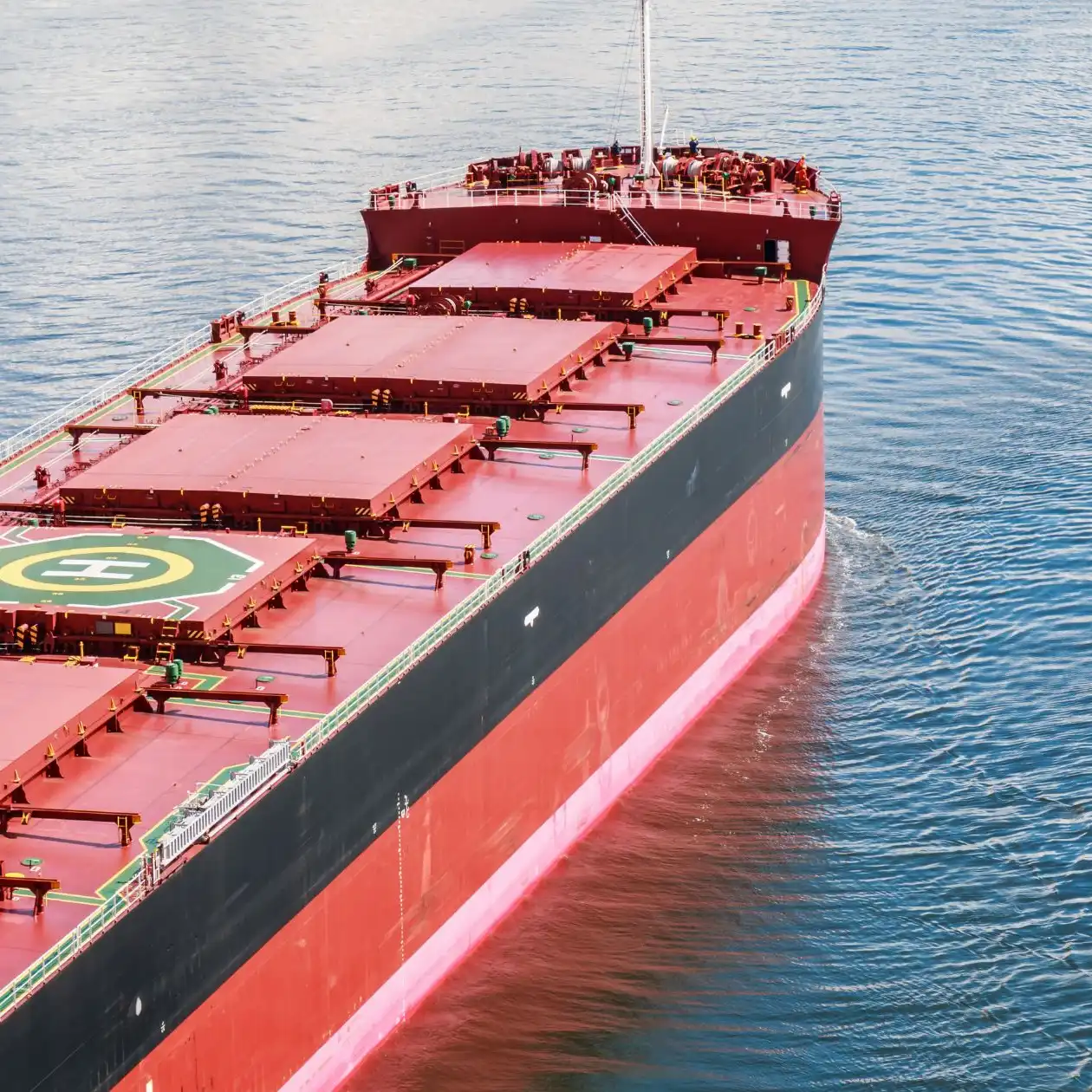
The structural identifiers of a Capesize are the long, near-block hull, nine holds and nine hatches running fore-to-aft, gearless main deck, single-island aft superstructure, raked stem, and transom stern. The hull is optimised for a single dense cargo loaded by shore conveyor and discharged by grab or shore crane, so the deck is left clear and the cargo gear that geared smaller classes carry is omitted. The 45m beam and 18m draught place the class outside the Panama Canal old-lock dimensions (32.31m beam) and outside the Suez Canal for the larger units, which is the historical reason the class routes Cape rather than canal.
Reference example
Representative modern Capesize, Brazil to China iron ore
- Vessel (composite)
- Modern 180,000 DWT Capesize, single-hull conventional
- IMO
- Representative; specific IMO withheld pending verification
- Built
- 2018 to 2022 vintage
- DWT
- 180,000 t summer
- Dimensions
- LOA 292m, beam 45m, draught 18.1m
- Holds and hatches
- 9 / 9, gearless
- Typical trade
- Tubarao to Qingdao iron ore
This fixture template represents the mainstream modern Capesize that lifts 170,000 t iron ore parcels from Tubarao or Ponta da Madeira to Qingdao or Caofeidian. The vessel pedigree across the modern fleet is dominated by Chinese, Japanese and Korean yards, with ownership concentrated in Berge Bulk, NYK, Star Bulk, Golden Ocean, and the Vale-controlled Valemax programme for the largest VLOC units.
Around 11,500 nautical miles one way around Cape of Good Hope, the modern Capesize on slow-steaming completes a round voyage in approximately 65 to 75 days laden plus ballast. Loading at Tubarao runs at shore-conveyor rates of 5,000 to 8,000 t per hour, and discharge at the tier-one Chinese receivers runs at 30,000 to 60,000 t per day on grab and conveyor handling.
Named ultra-large ore carriers sit well above the standard Capesize band rather than inside it. The Berge Stahl (IMO 8420804, 364,767 DWT, built 1986, beam 63.5m, in service to 2021) and the Vale Brasil class Valemax tonnage are VLOC and ULOC examples, not standard Capesize.
Common chartering considerations
- Hire-rate volatility: Capesize is the cyclical bellwether of the dry bulk fleet. The Baltic Capesize Index can move 20 percent in a fortnight on a single iron ore stockpile signal. Operators carry more spot-market beta on Capesize than on any other mainstream class.
- Baltic Capesize Index, C5 and C3: the canonical spot routes are C5 (West Australia to Qingdao) and C3 (Tubarao to Qingdao). Most spot fixtures price against the BCI print, often with a percentage of index in the freight clause. The Capesize 5TC time-charter average is the standard period-fixture benchmark.
- Lay-up risk in down cycles: the Capesize fleet runs the largest standby and lay-up exposure in dry bulk. In a deep cyclical trough the daily operating cost of a Capesize at sea is higher than the spot earnings, and the rational owner response is to lay up. The threshold typically sits around 8,000 to 10,000 USD/day TCE per Clarksons cycle data.
- Fuel consumption: a modern Capesize on slow steaming burns approximately 50 to 55 t/day of VLSFO at 14 knots laden. Bunker exposure is the dominant variable cost on the longer Brazil to China round voyages, and bunker-clause language is a fixture-level negotiation.
- EEXI and CII implications: the IMO energy-efficiency (EEXI) and carbon-intensity (CII) regulations, in force since 1 January 2023 (IMO resolutions MEPC.328(76) and MEPC.336(76)) with the first CII ratings issued in 2024, bite hardest on older Capesize tonnage. CII ratings of D and E force operational adjustments (slower steaming, route choice) that interact with charter-party speed and consumption warranties.
- Insurance and casualty exposure: the Capesize fleet runs the largest single-vessel insured-value exposure in dry bulk. INTERCARGO casualty data shows the class is structurally over-represented in serious-casualty statistics, driven by iron ore liquefaction and weather-related hull failures on the long ballast legs.
Scope and what this page does not cover
This page describes the Capesize as a dry bulk vessel class, the dimensional band that defines it, and the cargo and lane structure it serves. It does not forecast Capesize hire rates or BCI prints, opine on sale-and-purchase decisions for specific vessels, or interpret jurisdiction-specific case law on Capesize casualties or charter-party disputes. For those, work with chartering counsel and a desk broker against current Baltic Exchange and Clarksons data. To put a Capesize stem in front of the desk, get a quote with your cargo, lane and laycan.