What is salt as a sea-borne cargo?
Salt is sodium chloride carried in dry bulk under the IMSBC Code SALT schedule. It ships as solar salt evaporated from seawater and as rock salt mined from underground deposits, classified Group C: non-hazardous, but corrosive to steel and demanding on hold cleanliness.
Sea-borne salt is a high-volume, low-value commodity that moves both as an industrial feedstock and as a winter de-icing material. The bulk of tonnage feeds the chlor-alkali industry, where salt is the raw input for chlorine and caustic soda, with the remainder split between road de-icing, water treatment, and food-grade refining. The shipping problem is straightforward in handling terms but unforgiving in two respects: the cargo is mildly hygroscopic and chemically aggressive toward unprotected mild steel, and any prior-cargo residue or moisture in the hold contaminates a product that buyers expect to arrive clean and free-flowing.
The regulatory anchor for sea carriage is the IMSBC Code 2024, schedule entry SALT. The schedule classifies salt as Group C, meaning it presents neither a chemical hazard nor a liquefaction risk under normal carriage. The live operational concerns are therefore not safety hazards but cargo-quality and ship-protection issues: corrosion of tank tops, hopper plating and bilge systems, and the hold-cleanliness standard required to avoid contamination claims at discharge.
Salt cargo properties
| Property | Value | Unit / Reference |
|---|---|---|
| Stowage factor | 0.89 to 1.11 | m3/t, varies by grade and moisture (IMSBC Code 2024, SALT schedule) |
| IMSBC group | Group C | Non-hazardous, no liquefaction or chemical hazard (IMSBC Code 2024) |
| IMSBC schedule entry | SALT | Single schedule covers solar and rock salt grades |
| Bulk density | 0.9 to 1.12 | t/m3, grade and moisture dependent (SALT schedule range) |
| Angle of repose | Not applicable | Not specified in the IMSBC SALT schedule |
| Transportable moisture limit | Not applicable | Group C, TML applies only to Group A cargoes |
| Corrosion and hold cleanliness | Corrosive to mild steel | IMSBC SALT schedule weather precaution and corrosion note |
| Reference | IMSBC Code 2024 edition | International Maritime Solid Bulk Cargoes Code, IMO |
The SALT schedule is operationally undemanding on safety but exacting on protection and quality. The stowage factor sits in the roughly 0.89 to 1.11 m3/t band, making salt a moderately dense, well-stowing cargo that rarely strains deadweight or volume limits on a conventional bulk carrier. The two properties that matter are corrosion and moisture. Sodium chloride accelerates corrosion of any exposed mild steel it contacts, so bilge wells, tank-top coatings and hold fittings carry a maintenance cost on a salt-heavy trade. Salt is also mildly hygroscopic: it picks up moisture from humid air, which can cause caking against the hold sides and complicate grab discharge if the holds are not kept sealed and dry.
Vessel typing and parcel sizes
| Vessel class | Suitability | Typical parcel size | Notes |
|---|---|---|---|
| Panamax | Common | 60,000 to 80,000 t | Long-haul chlor-alkali feedstock cargoes, Australia and Mexico to North Asia. Hold cleanliness critical for food and industrial grades. |
| Supramax | Dominant | 45,000 to 63,000 t | Workhorse for salt. Gear-equipped for receivers without shore cranes, suits mid-size de-icing and industrial parcels. |
| Handymax | Common | 40,000 to 50,000 t | Regional and seasonal de-icing lanes into North America and Europe. Flexible on draught-limited berths. |
| Handysize | Common | 20,000 to 38,000 t | Smaller industrial and food-grade parcels, coastal redistribution. Higher freight per tonne. |
Salt parcel-size economics favour the geared Handysize-to-Supramax band more than most bulk commodities. The reason is the receiver fleet: salt frequently discharges at industrial chemical plants, de-icing depots and coastal terminals that lack the deep-water berths and high-capacity shore cranes that coal or iron-ore receivers operate. Geared tonnage that can self-discharge by grab is therefore at a premium, which pushes the trade toward Supramax and Handymax over gearless Panamax on most lanes. The largest chlor-alkali feedstock movements, typically Australia or Mexico to North Asia, do run on Panamax where the discharge plant can take the parcel, but the seasonal de-icing trade into North America and Northern Europe leans heavily on Handysize and Handymax.
Hold cleanliness is the single most under-priced operational issue in the salt trade, as it is in coal but for the opposite reason. A vessel that lifted coal, pet coke or fertilizer on the previous voyage and is then nominated for salt will fail hold inspection on residual dust or staining, because salt buyers, especially food and water-treatment grades, hold the cargo to a near-cosmetic cleanliness standard. The master must book a full hold wash, often with freshwater rinse and surveyor sign-off, before the laycan opens.
How salt ships in practice
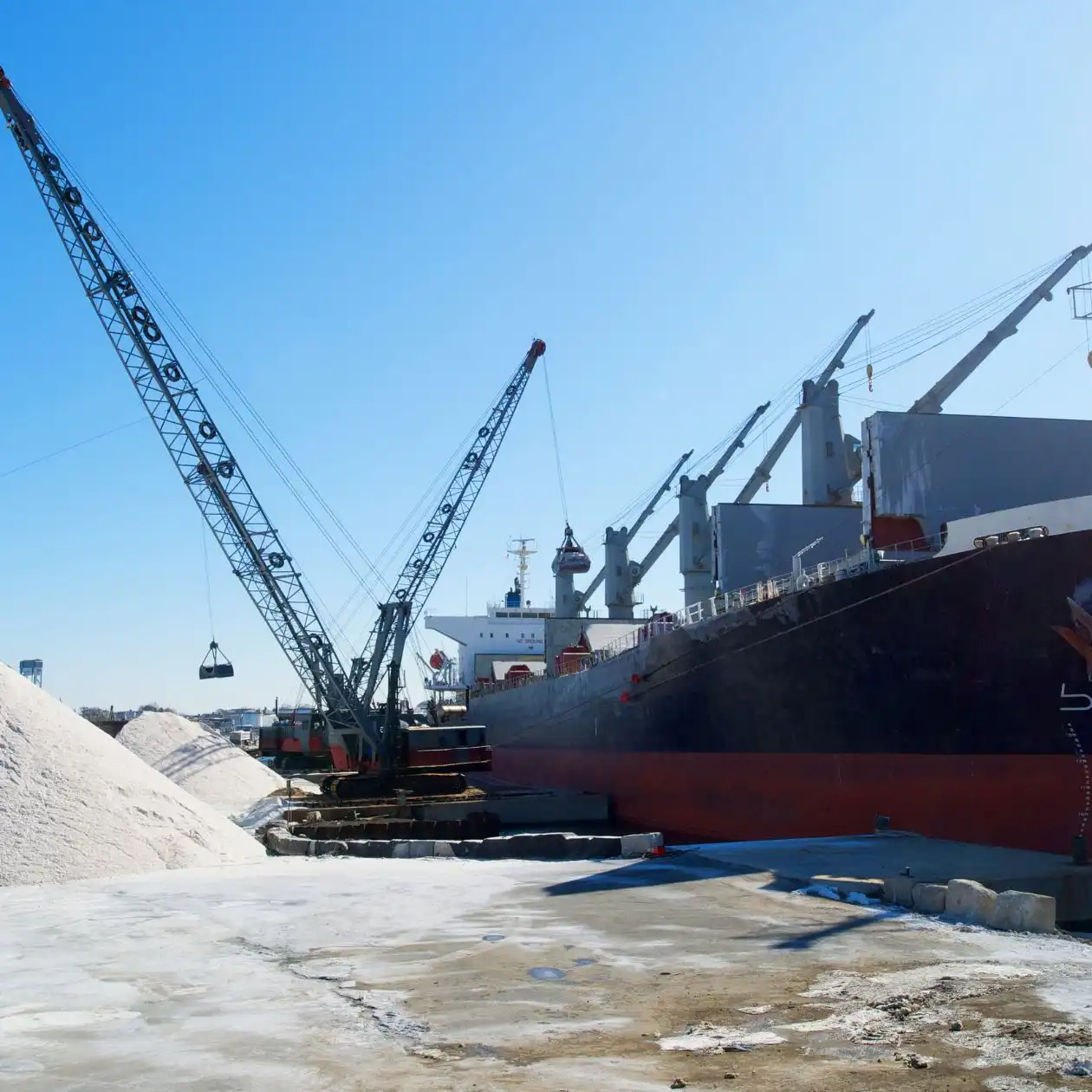
Salt loads by shore conveyor at dedicated solar-salt fields and by conveyor or front-end loader at rock-salt mine terminals. Solar salt from large evaporation works in Australia, Mexico and India loads at high conveyor rates where the berth allows, while smaller rock-salt and de-icing parcels load more slowly at multi-purpose berths by grab or loader. The loading plan is conventional for a Group C cargo: there is no surface-levelling safety requirement of the kind the COAL schedule imposes, but the master will still trim to protect stability and to keep the cargo clear of bilge wells where corrosion and moisture pool.
Voyage care turns on keeping the holds sealed and dry. Because salt is hygroscopic and corrosive, the SALT schedule’s weather precaution is the governing instruction: holds are kept closed against rain and spray, and ventilation is managed to avoid drawing humid air over the cargo, which would promote caking and accelerate corrosion of exposed steel. There is no gas, temperature or oxygen monitoring regime, which makes salt a low-supervision cargo on passage compared with the self-heating fuel cargoes.
Discharge is predominantly by grab and shore crane, or by the vessel’s own gear at receivers without shore cranes, into industrial plant hoppers, de-icing stockpiles and covered storage. The fixture is normally one parcel per vessel on FIO terms, with laytime and demurrage negotiated against the receiving terminal’s published norm. Salt does not part-load with dissimilar cargoes because of the contamination and cleaning cost. See loading and discharge rate for the contractual mechanics and voyage charter for the dominant fixture structure.
Major trade routes
- Australia to North Asia: solar salt for chlor-alkali feedstock into China, Japan, Korea and Taiwan. Panamax and Supramax dominant. Large evaporation works in Western Australia anchor the Pacific industrial trade. Volumes desk-flagged pending a named trade-flow source.
- Mexico to North Asia and US West Coast: solar salt from Pacific Mexican evaporation fields, Supramax and Panamax, feeding both chlor-alkali plants and West Coast industrial users. Volumes desk-flagged.
- India and Middle East to Southeast Asia and East Asia: solar salt and industrial salt, Handysize and Supramax, serving regional chlor-alkali and food markets. Volumes desk-flagged.
- Europe and North Africa to North America (seasonal de-icing): rock salt and solar salt into US and Canadian East Coast de-icing depots, Handysize and Handymax, with a strong winter seasonal peak. Volumes desk-flagged.
- Egypt and Mediterranean to Northern Europe: solar and rock salt into industrial and de-icing receivers, Handysize and Handymax, draught-limited at some receiving berths. Volumes desk-flagged.
The salt trade is structurally split between a steady, year-round industrial chlor-alkali flow and a sharply seasonal de-icing flow that peaks ahead of and during the Northern Hemisphere winter. The de-icing leg is weather-driven and can swing materially year to year with snowfall, which makes it a spot-charter market that absorbs Handysize and Handymax tonnage when winter demand spikes. For the wider lane catalogue across dry bulk see the dry-bulk-shipping hub and the routes and markets overview.
Salt vs sulphur
Salt and sulphur are both corrosion-relevant cargoes that ship on similar geared vessel classes, and both feed heavy-chemical industry, so they are sometimes grouped loosely as corrosive bulk feedstocks. They are not the same cargo class and the IMSBC treats them very differently.
| Salt | Sulphur (formed or crushed lump) | |
|---|---|---|
| IMSBC group | Group C | Group C (formed or crushed lump sulphur schedule) |
| Primary concern | Corrosion and hold cleanliness | Corrosion, dust, and combustible dust ignition risk |
| Stowage factor | 0.89 to 1.11 m3/t | Generalized: see the IMSBC sulphur schedule |
| Hazard profile | Non-hazardous | Dust can be combustible; sulphur dioxide on moisture contact |
| IMSBC schedule | SALT | SULPHUR (formed, solid or crushed lump) |
| Typical end use | Chlor-alkali feedstock, de-icing, food and water treatment | Sulphuric acid, fertilizer, industrial chemicals |
Both cargoes are corrosive to mild steel and both reward clean, dry holds, which is the shared operational thread. The key difference is hazard: salt is genuinely non-hazardous, whereas sulphur dust is combustible and reacts with moisture to form acidic conditions, so the sulphur schedule carries dust-control and ignition precautions that salt does not. A fixture written against the wrong schedule will fail the loadport survey, and the two cargoes carry different acceptance and hold-preparation rules at the receiving plant.
Reference example
Supramax solar salt, Western Australia to North Asia
- Cargo grade
- 55,000 mt solar salt, industrial chlor-alkali grade
- Lane
- Western Australia solar field to North Asia chlor-alkali plant
- Vessel band
- Geared Supramax, 58,000 dwt
- Parcel size
- 55,000 mt
- Loading rate
- 20,000 T/D SHINC, shore conveyor
- Discharge rate
- 12,000 T/D SHINC, grab and ship's gear into plant hopper
- Notable clause
- Holds clean, dry and free of prior-cargo residue to surveyor satisfaction before loading; freight prepaid against original BL
The lane is a steady industrial movement rather than a weather-driven spot trade. Loading at the solar field uses a dedicated shore conveyor, which gives a clean, even load with little dust compared with grab loading. Voyage care is low-supervision: there is no gas, temperature or oxygen monitoring under the Group C SALT schedule, so the master’s attention is on keeping the holds sealed against rain and spray to prevent caking and protect the cargo’s free-flowing condition.
Hold preparation at the previous discharge port was the gating step. The receiver, a chlor-alkali plant, holds the salt to an industrial cleanliness standard, so the holds were washed, freshwater rinsed and surveyed clean and dry before the laycan opened. Residual dust or staining from a prior coal or fertilizer cargo would have failed the inspection outright.
The fixture was on FIO terms with laytime calculated against weather working days SHINC at both ends. Discharge by the ship’s own gear into the plant hopper kept the vessel independent of shore-crane availability, which is the operational reason geared tonnage is preferred on salt lanes into industrial receivers.
Common loading and discharge issues
- Corrosion of tank tops, bilges and hold fittings: sodium chloride accelerates corrosion of any exposed mild steel, and the damage compounds across a salt-heavy fleet’s drydock cycle. The cost rarely shows on a single fixture but feeds the longer-term maintenance bill, especially around bilge wells and hopper plating where moisture pools.
- Hold-cleanliness rejection at loading: salt buyers, particularly food, water-treatment and chlor-alkali receivers, hold the cargo to a near-cosmetic cleanliness standard. Residual dust or staining from a prior coal, pet coke or fertilizer cargo causes outright loadport rejection until the holds are re-washed and re-surveyed.
- Caking and moisture pickup: salt is mildly hygroscopic, so humid air drawn over the cargo or rain ingress through poorly sealed hatches causes caking against the hold sides, which slows grab discharge and can prompt a quality dispute at the receiver.
- Contamination claim at discharge: if residue or moisture has degraded the cargo’s free-flowing condition or introduced foreign matter, the receiver may open a quality claim. The master’s pre-loading hold-cleanliness survey certificate is the evidentiary defence.
- TML and Group A documentation confusion: TML does not apply to salt, but loaders occasionally apply Group A liquefaction documentation by mistake, causing certificate delays at the loadport. The correct schedule is SALT, Group C, with no TML certificate required.
- Bilge system blockage and corrosion: fine salt working into bilge wells can both block the system and accelerate corrosion there, so bilge soundings and cleaning are a recurring attention point on salt voyages.
Scope and what this page does not cover
This page explains salt as a sea-borne dry bulk commodity, the IMSBC operational regime that governs its carriage, and the dominant vessel-class and lane structure. It does not forecast salt prices, quantify exact trade volumes by lane, opine on which load region to fix from in a given season, or interpret jurisdiction-specific cargo-claim case law on contamination or corrosion damage. The route volumes above are directional and flagged for desk verification against a named trade-flow source. For commercial decisions, work with chartering counsel and a desk broker against current trade-flow and freight data. To move a salt parcel, get a quote and the desk will match geared tonnage to your receiver and grade.