What is a Handymax bulk carrier?
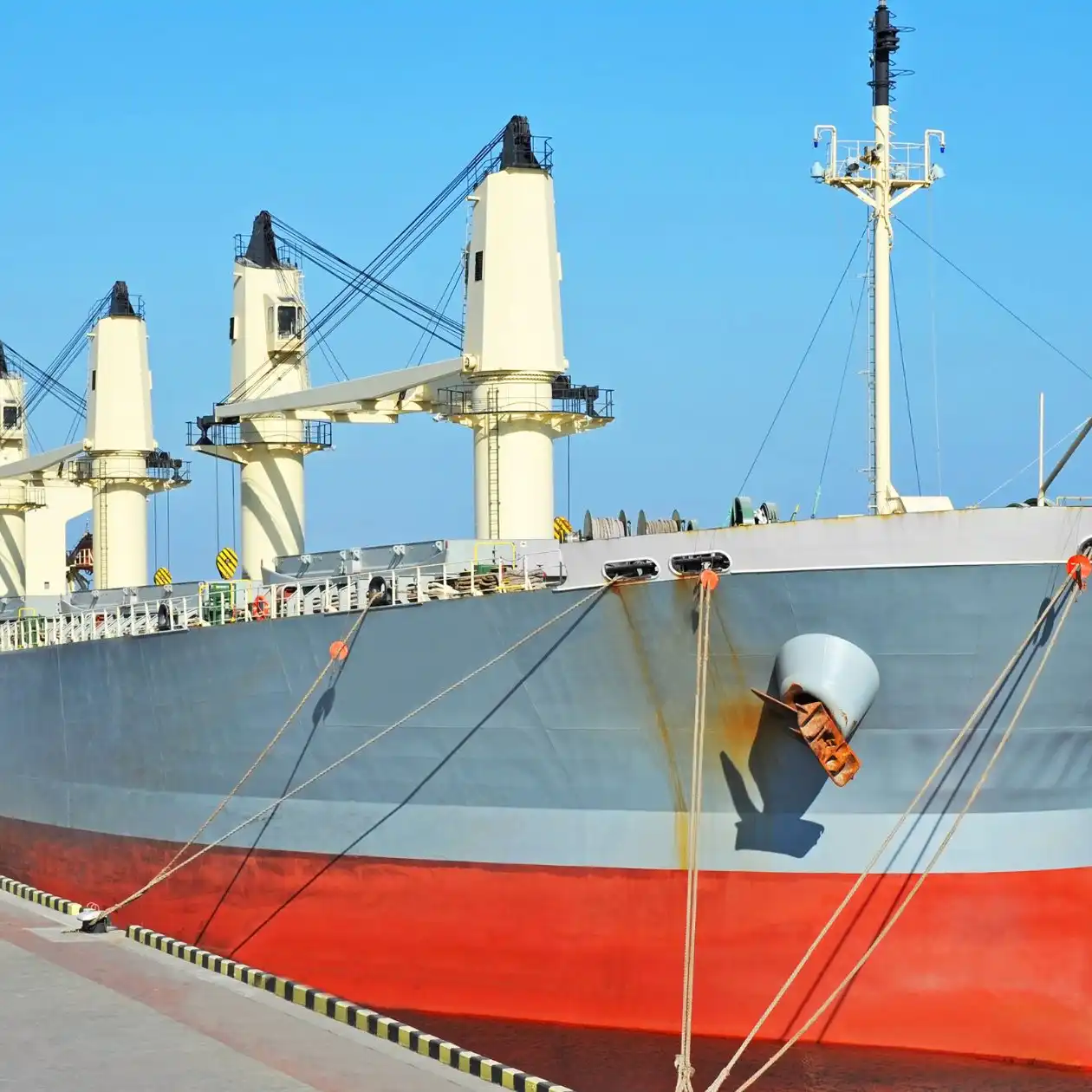
A Handymax is a geared bulk carrier of roughly 40,000 to 50,000 deadweight tonnes, named as the handy maximum tier, fitted with four deck cranes. It is increasingly an obsolete classification as fleet replacement skews to Supramax and Ultramax tonnage above 50,000 DWT.
The class sat for two decades between the smaller Handysize (then 28,000 to 40,000 t) and the larger geared Supramax (now 50,000 to 60,000 t). Lloyd’s Register and DNV class registers continue to record Handymax tonnage on the active fleet, but Clarksons newbuild orderbook data shows the class is no longer a target for newbuild ordering. Owners replacing older Handymax tonnage step up to Supramax or Ultramax rather than staying in the 40,000 to 50,000 t band.
The class boundary is fuzzy. Some sources treat Handymax as 35,000 to 50,000 t, others as 40,000 to 60,000 t with overlap into the Supramax band. The cleanest contemporary definition is 40,000 to 50,000 t, geared with 4 x 25 to 30 t cranes, five-hold and five-hatch configuration, with a build vintage that is now predominantly pre-2010.
Handymax specifications
| Specification | Value | Source |
|---|---|---|
| DWT range | 40,000 to 50,000 t (boundary overlap with Supramax above) | Clarksons fleet data; Lloyd's Register class data |
| LOA | 175 to 190 m | Clarksons fleet data, dominant Handymax builds 1990 to 2010 |
| Beam | 28 to 32 m | Clarksons fleet data |
| Draught (summer) | 11.0 to 12.0 m | Lloyd's Register class data, load-line assignment |
| Holds | 5 | Standard Handymax design |
| Hatches | 5 | Standard Handymax design |
| Gear configuration | Geared, 4 x 25 to 30 t SWL cranes | Clarksons fleet data; class society registers |
| Cubic capacity | 55,000 to 65,000 m3 (grain) | Clarksons fleet data |
| Service speed (laden) | 13 to 14 kn | Clarksons fleet data |
| Typical cargoes | Grain, coal, fertilizer, cement, steel products | Major operator trade reports; older Baltic Exchange Handymax routes |
| Newbuild status | Class largely replaced by Supramax / Ultramax post-2010 | Clarksons newbuild orderbook trend |
The Handymax sub-class boundaries are not as cleanly defined as the Supramax tier above. Active Handymax tonnage today is predominantly pre-2010 build, with electronically-controlled main engines uncommon. Some older sources stretch the upper bound to 60,000 t, which is now firmly Supramax territory. The 40,000 to 50,000 t band today is mostly older tonnage that competes with both newer Supramax and newer Handysize on regional lanes.
Handymax vs adjacent classes
| Class | DWT band | Port accessibility | Dominant trades / lanes | Hire rate range (USD/day) |
|---|---|---|---|---|
| Handymax | 40,000 to 50,000 t | Strong port reach, geared 4 x 25 to 30 t. Draught 11.0 to 12.0 m. | Regional and intra-basin lanes, older fleet niches, second-hand market | 9,000 to 13,000 (mid-cycle) |
| Supramax | 50,000 to 60,000 t | Most worldwide bulk ports, geared 4 x 30 to 35 t. Draught 12.0 to 12.5 m. | Intra-Asia coal, ECSA grain, US Gulf grain, NW Europe to W Africa | 11,000 to 16,000 (mid-cycle, S10TC) |
| Handysize | 28,000 to 40,000 t | Greatest port flexibility, geared 4 x 25 to 30 t. Draught 9.5 to 10.5 m. | Feeder trades, intra-regional, smaller parcels, niche cargoes | 8,000 to 12,000 (mid-cycle, BHSI) |
Selection between Handymax and Supramax is now largely driven by fleet vintage and absolute hire rate, not by mission fit. Charterers fixing time-charter trips on the S10TC index almost always mean Supramax. A Handymax fixture in 2026 typically appears when an older vessel is available at a discount, when a regional lane has insufficient Supramax tonnage, or when a second-hand candidate is being offered for sale on a one-trip basis. Owners holding Handymax tonnage compete on the secondary market and on lanes where the older vessel is acceptable.
Selection between Handymax and Handysize is more genuine. Handymax carries a parcel 10,000 to 15,000 t larger than Handysize on a draught roughly 1.5 m deeper. Charterers loading 40,000 to 45,000 t parcels for ports with 11.5 to 12.0 m draught restrictions reach for Handymax. Charterers with parcels under 35,000 t or with shallower port draught restrictions reach for Handysize. See the Handysize, Supramax, and Panamax pages for the surrounding classes.
Port accessibility and trade lanes
Handymax port accessibility is broadly similar to Supramax but with marginally shallower draught (11.0 to 12.0 m versus 12.0 to 12.5 m). The class fits the same global port pattern as Supramax. The trade-lane question is more about which lanes still see Handymax fixtures, given the limited fleet renewal.
- Older intra-Asia and Pacific basin lanes. Coal and steel from Australian and Indonesian loadings into Chinese, Indian, and SE Asian receivers. Active Handymax tonnage continues to serve these lanes alongside the larger Supramax fleet, often on smaller parcels (40,000 to 48,000 t) where the Supramax is overspecified.
- Atlantic basin minerals and grain. Bauxite from West Africa, manganese from South Africa, soybeans from ECSA into European receivers. Handymax appears on smaller stems and split parcels.
- NW Europe to West Africa. Steel, fertilizer, and project cargo from European ports into West African receivers. The geared configuration is essential; older Handymax tonnage competes with newer Supramax on this lane.
- Intra-Mediterranean and Black Sea. Grain, cement, and fertilizer inside the basin. Smaller parcel sizes and shorter haul make the Handymax economics competitive against Supramax.
- Intra-Caribbean and US Gulf coastwise. Smaller-parcel grain, fertilizer, and cement trades within the Atlantic basin. The class fits secondary lanes where the Supramax cannot fill the parcel.
- Niche second-hand and one-trip fixtures. Owners selling older Handymax tonnage occasionally offer the vessel for a single laden voyage en route to a buyer. These one-trip fixtures appear across the regional lanes above.
Draught flexibility of 11.0 to 12.0 m gives the Handymax port reach almost equivalent to Supramax. The constraint is fleet availability rather than physical port restriction.
Typical cargoes and parcel sizes
Handymax cargo flexibility is similar to Supramax with smaller parcel sizes. Typical parcel sizes by cargo type:
- Grain (soybeans, corn, wheat): 40,000 to 48,000 t parcels. Smaller intra-basin and feeder grain trades.
- Coal (thermal and metallurgical): 42,000 to 48,000 t parcels. Smaller intra-Asia and Atlantic-basin parcels where the Supramax is overspecified.
- Fertilizer (urea, DAP, potash): 35,000 to 48,000 t parcels. Regional fertilizer lanes outside the dominant Panamax and Supramax flows.
- Cement and clinker: 30,000 to 45,000 t parcels. Intra-regional cement trades, Asia to Africa, intra-Mediterranean.
- Steel products (rebar, coils, plates): 25,000 to 45,000 t parcels. Smaller intra-regional and China-to-Africa steel trades.
- Sugar (raw and refined): 30,000 to 48,000 t parcels. Smaller stems on Brazilian and Thai exports.
- Bauxite, manganese, and iron-ore concentrates: 40,000 to 48,000 t parcels. Smaller Atlantic-basin and intra-Asia lanes.
As with Supramax, split-parcel fixtures (two cargoes loaded together, or one cargo split across two discharge ports) are common, supported by the four-crane gear and five-hold configuration.
Vessel profile
The Handymax profile is similar to the Supramax but with a slightly shorter LOA, narrower beam, and shallower draught. Five box-shaped holds run the length of the cargo block, served by single hatches with steel folding hatch covers. Four deck cranes (25 to 30 t SWL) sit between the hatches with grab buckets for self-discharge. The deckhouse and engine room sit at the stern. Older Handymax vessels have conventional non-electronically-controlled main engines and pre-Tier III NOx compliance, which factors into bunker consumption and emissions-zone access.
Reference example
Star Bulk Handymax workhorse, Atlantic basin
- Vessel name
- Representative Handymax, pre-2010 build (composite, see flag)
- IMO
- Composite, not a single vessel (verify against operator fleet register)
- Operator type
- Mid-size Atlantic basin operator (Star Bulk, Diana Shipping, Genco Shipping comparable)
- Year built
- 2004 to 2008 typical for active Handymax tonnage
- DWT
- 45,000 to 48,000 t
- LOA
- 182 to 189 m
- Beam
- 30 to 32 m
- Draught (summer)
- 11.5 to 11.8 m
- Gear
- 4 x 25 to 30 t SWL cranes
- Typical trade
- Atlantic-basin grain, intra-Med fertilizer, NW Europe to W Africa steel
The fixture above is a representative composite, not a named individual vessel. Active Handymax tonnage is predominantly pre-2010 build and the operator footprint is fragmented across mid-size Atlantic-basin owners. The composite is flagged in desk-review for replacement with a named vessel and confirmed IMO if a specific recent fixture is available.
Common chartering considerations
- Aging fleet and limited newbuild renewal. Active Handymax tonnage is predominantly pre-2010 build. Owners replacing older tonnage step up to Supramax or Ultramax rather than staying in the 40,000 to 50,000 t band. This shapes available fleet, age premium, and the second-hand market.
- Secondary market depth. The Handymax band sees more second-hand sale activity than newbuild ordering. One-trip and consecutive-voyage fixtures associated with vessels under sale negotiation appear in the lane mix.
- Fuel consumption is around 20 to 23 t per day at service speed. Older Handymax tonnage with conventional main engines consumes more than equivalent Supramax eco-builds, which is one reason the class has lost newbuild momentum to Ultramax.
- Hire rate discount against Supramax. Handymax fixtures typically transact at 1,500 to 3,000 USD per day below equivalent Supramax in mid-cycle markets, reflecting the smaller parcel, older vessel, and higher fuel consumption.
- Trip charter and voyage charter dominant. See the trip charter, voyage charter, and time charter pages for the contract structures used in the class.
- Class-society and emissions-zone compliance is a fixture-blocking issue. Pre-2010 tonnage may lack ballast-water treatment system (BWTS) compliance, Tier III NOx for emissions-control areas (ECAs), or other recent regulatory upgrades. Charterers screen Handymax candidates carefully for ECA fitness and BWTS status.
For the brokering-desk context on Handymax employment, sale, and purchase, contact the ship brokering team.
Scope and what this page does not cover
This page is an operational and vessel-spec briefing on the Handymax class. It does not publish daily hire rates, it does not forecast second-hand sale values, and it does not offer broker-desk opinion on individual Handymax fixtures or sale candidates. Class-society and flag-state certification detail, regulatory compliance for individual vessels, and Memorandum of Agreement (MOA) terms for second-hand sales are outside the scope of this page. For commercial advice on Handymax employment or sale and purchase, see the bulk-carriers hub, the vessel specifications reference, and the size comparison page. To fix a Handymax or compare it against Supramax tonnage for your cargo, get a quote.