What are wood pellets as a sea-borne cargo?
Wood pellets are a manufactured biomass fuel carried in dry bulk under the IMSBC Code WOOD PELLETS schedules. Compressed from sawdust and forestry residue, they ship as a solid renewable substitute for coal in power stations, classified Group B for off-gassing, oxygen depletion and self-heating.
Sea-borne wood pellet trade is a comparatively young dry bulk flow that grew with European and East Asian biomass power policy. Pellets are made by drying and pressing wood residue, sawdust and chip into uniform cylinders, then shipped to co-fired and dedicated biomass plants that burn them in place of thermal coal. The shipping problem is distinct from most dry bulk: pellets are low density, moisture sensitive, prone to dust and breakage on handling, and chemically active enough to consume oxygen and emit carbon monoxide inside a sealed hold.
The regulatory anchor for sea carriage is the IMSBC Code 2024, which carries two parallel entries: WOOD PELLETS CONTAINING ADDITIVES AND/OR BINDERS and WOOD PELLETS NOT CONTAINING ANY ADDITIVES AND/OR BINDERS. Both are classified Group B, meaning a chemical hazard rather than a liquefaction risk. Operationally this translates into three live concerns on every voyage: oxygen depletion in the headspace, carbon monoxide build-up, and self-heating of the cargo. The schedules require strict enclosed-space entry precautions and a defined ventilation and gas-monitoring regime.
Wood pellet cargo properties
| Property | Value | Unit / Reference |
|---|---|---|
| Stowage factor | 1.4 to 1.6 | m3/t, varies by pellet grade and moisture (IMSBC Code 2024, WOOD PELLETS schedules) |
| IMSBC group | Group B | Chemical hazard, not liquefaction (IMSBC Code 2024) |
| IMSBC schedule entries | WOOD PELLETS, two schedules | Containing additives and/or binders; not containing any additives and/or binders (IMSBC Code 2024) |
| Bulk density | Approximately 0.6 to 0.7 | t/m3, low-density cargo, grade dependent (industry estimate, desk-flagged) |
| Angle of repose | Approximately 30 to 38 degrees | Industry estimate, free-flowing cylindrical pellets (desk-flagged) |
| Transportable moisture limit | Not applicable | Group B, TML applies only to Group A cargoes |
| Hazard profile | CO emission, oxygen depletion, self-heating | IMSBC Code WOOD PELLETS schedules, special precautions |
| Reference | IMSBC Code 2024 edition | International Maritime Solid Bulk Cargoes Code, IMO |
The WOOD PELLETS schedules are operationally demanding for a reason that is the inverse of coal: the headspace hazard arrives fast and silently. Freshly produced pellets off-gas carbon monoxide and consume oxygen as the wood oxidises, so a sealed hold or an adjacent enclosed space can reach a lethal, oxygen-depleted atmosphere within hours of loading. This makes enclosed-space entry the single highest-risk activity on a pellet voyage, and the schedules require atmosphere testing and forced ventilation before any person enters a cargo or access space. Self-heating is the slower-burn concern on longer voyages, driven by residual moisture and microbial activity, and it is the reason pellet quality control at the mill matters to the carrier. The stowage factor sits high, roughly 1.4 to 1.6 m3/t per the schedules, so pellets are a volume cargo: a vessel typically cubes out before it deadweights.
Vessel typing and parcel sizes
| Vessel class | Suitability | Typical parcel size | Notes |
|---|---|---|---|
| Panamax | Dominant | 60,000 to 75,000 t | US Gulf and Canada long-haul to Northwest Europe and the UK. Cubes out before deadweight on a low-density cargo. |
| Supramax / Ultramax | Common | 40,000 to 60,000 t | Flexible biomass parcels, gear useful at receivers without dedicated pellet handling. Baltic and US flows to Europe. |
| Handymax | Common | 35,000 to 50,000 t | Smaller biomass parcels and shorter Baltic and intra-European lanes. |
| Handysize | Conditional | 20,000 to 35,000 t | Niche feeder lanes, smaller plants and seasonal top-ups. Higher freight per tonne. |
Wood pellet parcel sizing is driven by volume, not weight, because the cargo is light. A vessel loading pellets generally fills its hold cube and reaches its loadline marks well before it touches its deadweight, so the relevant decision is how much cube a class offers per dollar of freight. Long-haul Atlantic exports from the US Gulf and Canada to Northwest European and UK biomass plants default to Panamax tonnage, where the freight saving per delivered tonne is material over a 3,500 to 4,000 nautical mile voyage. Shorter Baltic and intra-European pellet flows run on Supramax, Handymax and Handysize tonnage, where parcel sizes are smaller and receiving berths shallower. See the bulk-carriers hub for the full class catalogue.
Hold cleanliness and dryness matter more for pellets than for most fuels. Pellets degrade on contact with moisture, swelling and crumbling into dust, so any residual seawater, sweat or hold wash water can damage the cargo and trigger a quality claim. A vessel switching into pellets from a wet or dusty previous cargo will be held to a high hold-inspection standard at the loadport.
How wood pellets ship in practice
Wood pellets load predominantly by shore conveyor at dedicated biomass terminals, often from covered silos to limit moisture pick-up and dust generation. Loading rates vary by terminal and by how much cascade or telescopic chute equipment is fitted to control breakage, since every transfer point that drops pellets generates fines and dust. The master’s loading plan must respect the schedules’ requirement to keep ignition sources clear, because wood dust suspended in air is combustible, and to limit handling that crumbles the pellet and raises the dust load.
Voyage care turns on the headspace atmosphere. The IMSBC WOOD PELLETS schedules prescribe a ventilation and gas-monitoring regime, with carbon monoxide and oxygen measured in the cargo space and any adjacent enclosed space, and they mandate enclosed-space entry precautions: no entry without atmosphere testing, ventilation and a permit. Hatch covers are generally kept closed and weather-sealed to protect the cargo from rain and sea spray, since wetting damage is the dominant cargo-quality risk. The combination of a sealed, moisture-protected hold and an oxygen-depleting cargo is exactly what makes the enclosed-space hazard so acute.
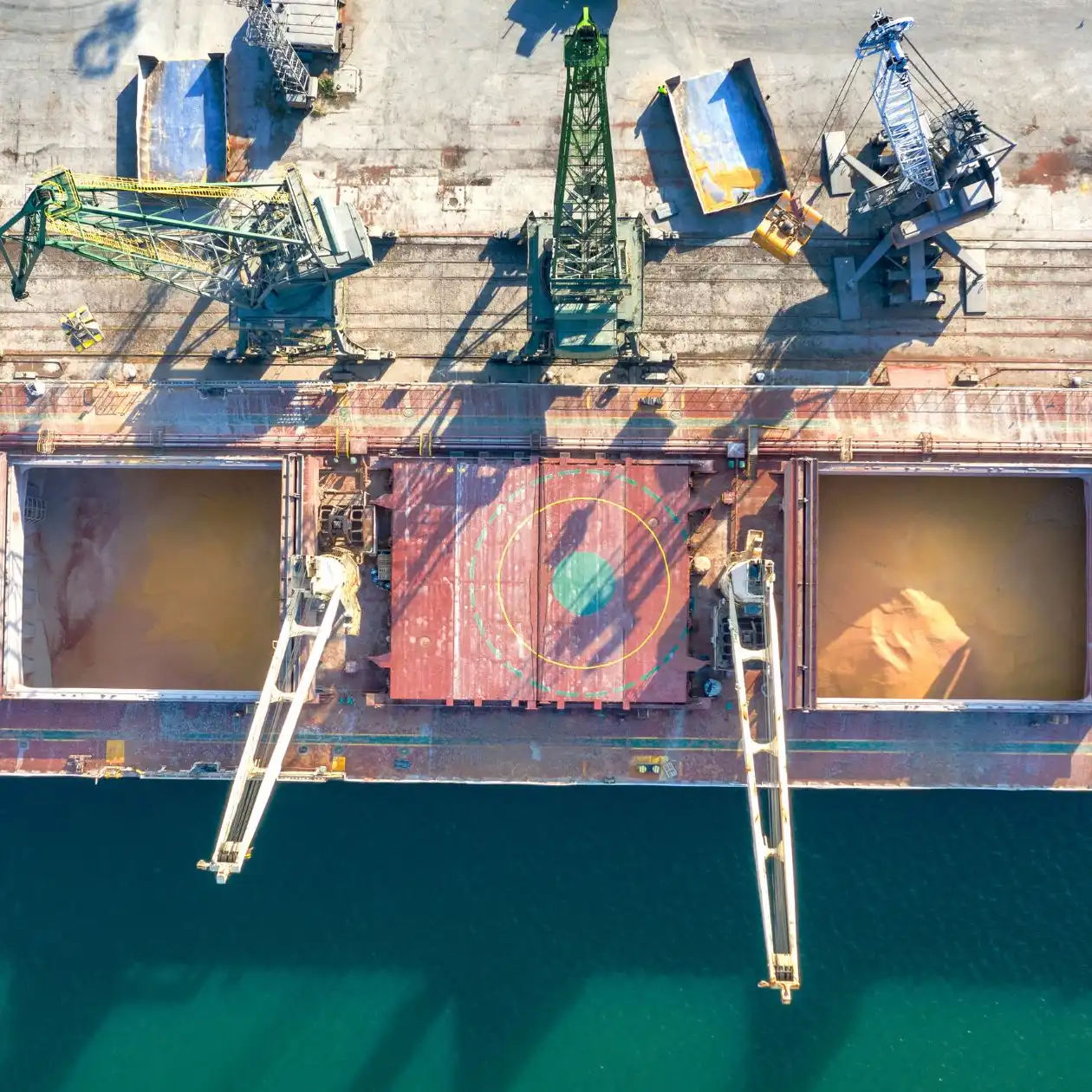
Discharge is by grab and shore crane or by pneumatic and conveyor systems at dedicated biomass berths, with the receiving plant feeding pellets onto covered conveyors to its on-site storage domes. Pellets do not part-load with other cargoes because of contamination and moisture risk, so the dominant structure is one parcel per vessel. The fixture is typically on FIO terms with laytime and demurrage negotiated against the terminal norm, and the agreed loading and discharge rate reflects the slower, breakage-controlled handling pellets require.
Major trade routes
- US Southeast and Gulf to UK and Northwest Europe: the structural core of the long-haul pellet trade, feeding large UK and continental biomass plants, Panamax-dominant on a roughly 3,500 to 4,000 nautical mile lane. Volume figures vary by source and are desk-flagged below.
- Canada (British Columbia and East coast) to UK, Europe and Japan/Korea: Canadian pellet exports run both Atlantic to Europe and Pacific to East Asian co-firing plants, Panamax and Supramax. Volumes desk-flagged.
- Baltic and Russia/Belarus historic to Northwest Europe: intra-European and Baltic flows on Handymax and Supramax tonnage, restructured significantly after 2022 trade shifts. Volumes desk-flagged.
- US and Canada to Japan and South Korea: the growing Pacific biomass lane into East Asian co-fired and dedicated plants, Panamax and Supramax. Volumes desk-flagged.
- Vietnam and Southeast Asia to Japan and Korea: a regional Pacific pellet flow supplying East Asian biomass demand, smaller parcels on Handymax and Supramax. Volumes desk-flagged.
The Atlantic basin, principally US and Canadian exports into European and UK biomass plants, has been the volumetric heart of the trade, with a growing Pacific leg into Japan and South Korea. Because the trade tracks national biomass and renewable-energy policy, lane volumes move with subsidy and import-rule changes rather than with classic commodity cycles. For the wider lane catalogue see the routes and markets hub and the dry-bulk-shipping hub.
Wood pellets vs coal
Wood pellets and coal are both Group B solid fuels that ship into many of the same power-generation receivers, and pellets are explicitly marketed as a renewable substitute for thermal coal. They are not interchangeable as cargoes.
| Wood pellets | Coal (thermal) | |
|---|---|---|
| IMSBC group | Group B | Group B |
| Stowage factor | 1.4 to 1.6 m3/t | 0.79 to 1.53 m3/t |
| Bulk density | Approximately 0.6 to 0.7 t/m3 | 0.65 to 1.27 t/m3 |
| Dominant hazard | CO emission, oxygen depletion, self-heating | Self-heating, methane, oxygen depletion, sulphur |
| IMSBC schedule | WOOD PELLETS (with or without additives/binders) | COAL |
| Cargo loading driver | Volume, vessel cubes out | Weight, vessel deadweights out |
| Key quality risk | Wetting, breakage and dust | Heating damage and dust |
The defining contrast is fuel type and loading economics. Pellets are a low-density, moisture-sensitive renewable fuel that fills the hold cube before it loads to its marks, while coal is a denser fossil fuel that loads to deadweight. Both off-gas and deplete oxygen, but the pellet enclosed-space hazard is faster and the headline carbon monoxide risk more acute, whereas coal adds methane and sulphur to the mix. Use the WOOD PELLETS schedule for manufactured biomass pellets and the COAL schedule for mined coal: a fixture written against the wrong schedule will fail the loadport survey.
Reference example
Panamax wood pellets, US Gulf to Northwest Europe
- Cargo grade
- 62,000 mt industrial wood pellets, IMSBC WOOD PELLETS not containing additives and/or binders
- Lane
- US Gulf biomass terminal to Northwest Europe power-plant berth
- Vessel band
- Modern Panamax, cubes out on low-density cargo
- Parcel size
- 62,000 mt, hold cube limited
- Loading rate
- Conveyor from covered silo, breakage-controlled chute
- Discharge rate
- Grab and conveyor to covered on-site storage
- Notable clause
- IMSBC WOOD PELLETS enclosed-space entry and ventilation clause, CO and oxygen monitoring log, hold dryness and cleanliness warranty, freight prepaid against original BL
The lane runs roughly 3,800 nautical miles one way and is the structural core of the Atlantic pellet trade into European biomass plants. The Panamax fills its hold cube and reaches its loadline marks well before deadweight, which is why a comparatively modest 62,000 mt parcel is a full cargo on a vessel that would lift far more coal.
Hold preparation before the laycan focused on dryness rather than just cleanliness, with bilges, hatch seals and any sweat-prone surfaces checked and signed off by surveyor before loading, because wetting is the dominant cargo-quality risk on pellets. The master’s voyage log captured carbon monoxide and oxygen readings in the cargo and adjacent enclosed spaces, and the enclosed-space entry permit regime was enforced from the moment loading began.
The fixture was on FIO terms with laytime calculated against weather working days at both ends, and the loading and discharge rates reflected the slower, breakage-controlled handling pellets require versus a conveyor-blasted coal cargo. Demurrage was benchmarked to the spot Panamax daily rate for the month of fixture.
Common loading and discharge issues
- Oxygen depletion and CO in enclosed spaces: the most serious pellet hazard. Freshly loaded pellets consume oxygen and emit carbon monoxide, so cargo holds and adjacent enclosed spaces can become lethal within hours. The IMSBC WOOD PELLETS schedules require atmosphere testing, ventilation and a permit before any entry. In a fatal incident documented by the Swedish Transport Agency, an ordinary seaman on the bulk carrier Saga Spray died and a stevedore was seriously injured after entering an unventilated access trunk during discharge of a wood-pellet cargo at Helsingborg, Sweden in November 2006, after oxygen depletion and carbon monoxide built up in the hold: hazards the IMSBC Code and P&I clubs such as Skuld continue to flag for wood-pellet voyages.
- Wetting damage and quality claims: pellets swell, crumble and degrade on contact with moisture. Rain during loading, sea spray through poorly sealed hatches, or residual wash water can damage the cargo and trigger a claim. Hatch-seal integrity and hold dryness are checked harder than on most fuels.
- Self-heating from residual moisture: pellets with high residual moisture or poor mill quality control can self-heat on longer voyages through oxidation and microbial activity, raising both a safety and a cargo-quality concern. Mill quality matters to the carrier, not just the buyer.
- Dust and breakage on handling: every transfer point that drops pellets generates fines and combustible dust. Uncontrolled handling crumbles pellets into out-of-spec dust, reducing the deliverable tonnage and raising the dust-explosion risk at the berth.
- TML and moisture confusion with Group A cargoes: TML does not apply to wood pellets, but loaders occasionally apply Group A documentation by mistake. The correct entries are the WOOD PELLETS Group B schedules, with no TML certificate required.
- Wrong schedule cited for additives versus no additives: the cargo declaration must name the correct schedule depending on whether the pellet contains additives or binders. A mismatch against the shipper’s product can delay the certificate of readiness at the loadport.
Scope and what this page does not cover
This page explains wood pellets as a sea-borne dry bulk biomass commodity, the IMSBC operational regime that governs their carriage, and the dominant vessel-class and lane structure. It does not forecast pellet prices, model biomass subsidy policy, opine on which export region to fix from next quarter, or interpret jurisdiction-specific cargo-claim case law on wetting or heating damage. For those, work with chartering counsel and a desk broker against current Baltic Exchange and named biomass-market data, and confirm every figure here against the source before relying on it. To move a wood pellet parcel, get a quote and the desk will size cube-limited tonnage to your lane.