What is cement as a sea-borne cargo?
Cement is a fine grey hydraulic powder, typically Portland-type, shipped in bulk as IMSBC Group C cargo with a stowage factor of 0.65 to 0.75 cubic metres per tonne and an absolute intolerance for moisture or hold contamination.
Cement is the finished construction binder produced by grinding clinker with gypsum and minor additions. As a sea cargo it sits in the IMSBC Code 2024 schedule under the entry CEMENT, classified Group C (no liquefaction risk, no chemical hazard). The operational reality is the opposite of the regulatory simplicity: cement is one of the most demanding dry bulk cargoes to carry because it is fine enough to behave like a fluid in the hold, sets irreversibly on contact with water, and produces a dust nuisance at urban discharge ports. The carriage requirements sit in the CEMENT schedule itself, which sets the dust protection, moisture, and trimming provisions.
A material share of global cement trade also moves on specialist cement carriers, self-discharging vessels fitted with pneumatic systems and dust-tight holds. These sit outside the conventional dry bulk fleet and trade on dedicated lanes with cement majors. For conventional bulk carriers, cement is a high-risk fixture that demands rigorous prior-cargo discipline, which is why broker desks treat the cement order book separately from grain, ore and coal.
Cement cargo properties
| Property | Value | Unit / Reference |
|---|---|---|
| Stowage factor | 0.65 to 0.75 | m3/t (IMSBC Code 2024, CEMENT schedule) |
| Bulk density | 1.35 to 1.50 | t/m3 (loose, IMSBC schedule) |
| Angle of repose | Not applicable | Fluidises when aerated (IMSBC CEMENT schedule) |
| IMSBC group | Group C | IMSBC Code 2024 (no liquefaction risk, no chemical hazard) |
| IMSBC schedule entry | CEMENT | IMSBC Code 2024, individual schedule |
| Hazard classification | Not classified as IMDG | Non-hazardous bulk; dust nuisance only |
| Moisture content | Less than 1 pct typical | Producer mill certificate |
| Moisture sensitivity | Hygroscopic, sets on water contact | IMSBC Code 2024, CEMENT schedule |
| Self-heating | Nil | IMSBC schedule |
| Temperature on load | Ambient to 60 deg C if direct from mill | Producer despatch advice |
| Particle size | Predominantly less than 75 microns | ASTM C150 / EN 197-1 |
| Cleaning category | Cargo C (food-grade-equivalent cleanliness on residue side) | Industry hold-survey practice |
Vessel typing and parcel sizes
Cement is a Handysize and Supramax cargo by parcel structure, with specialist cement carriers filling the high-volume intra-major-producer trade. Capesize and Panamax tonnage is rarely fixed for cement because terminal infrastructure at the consumer end is sized for smaller parcels and because the hold-cleaning bill on a Capesize would be prohibitive for the freight earned.
| Vessel class | Suitability | Typical parcel size | Notes |
|---|---|---|---|
| Capesize | Rarely used | Not standard for cement | Hold cleaning cost and discharge infrastructure rule it out; see Capesize |
| Panamax | Occasional | 60,000 to 70,000 mt | Used for long-haul bulk cement between majors; see Panamax |
| Supramax | Workhorse | 45,000 to 55,000 mt | Geared tonnage useful where shore cranes are absent; see Supramax |
| Handysize | Dominant | 20,000 to 35,000 mt | Most cement consumer ports accept Handysize draught; see Handysize |
| Cement carrier (specialist) | Specialist subclass | 5,000 to 35,000 mt | Self-discharging with pneumatic systems (e.g. NovaAlgoma, Cargill cement fleet); not in the conventional spot pool |
For broker desks, the practical question is geared versus gearless. Consumer ports in West Africa, the Caribbean and parts of South-East Asia lack shore cranage, pushing orders toward geared Supramax and Handysize tonnage. Producer ports in Turkey, Vietnam and the Mediterranean are mostly fitted with terminal loading systems and accept gearless tonnage. Vessel typing collapses to draught at the discharge port and the receiver’s preference between grab and pneumatic discharge. See vessel size comparison and voyage charter for the commercial structure.
How cement ships in practice
Loading is by enclosed conveyor or pneumatic loader at producer terminals, by grab in lower-spec ports. Enclosed conveyor is preferred because cement dust is a regulatory issue under most port air-quality regimes. Pneumatic loading on a specialist cement carrier is faster and cleaner but requires compatible vessel and terminal systems. Grab loading at lower-spec ports is the worst case for dust and stowage uniformity.
Hold preparation is the operational gate that determines whether a cement fixture pays. Holds must be dry and free of all prior-cargo residue, with bilges sealed against free water. Any carry-over of salt, sugar, grain or moisture-bearing residue is grounds for the shipper to reject the vessel at owner’s time and cost. Most cement charter parties incorporate an independent hold-pass survey before notice of readiness is accepted, and the loading and discharge rate clause typically excludes time for hold remediation.
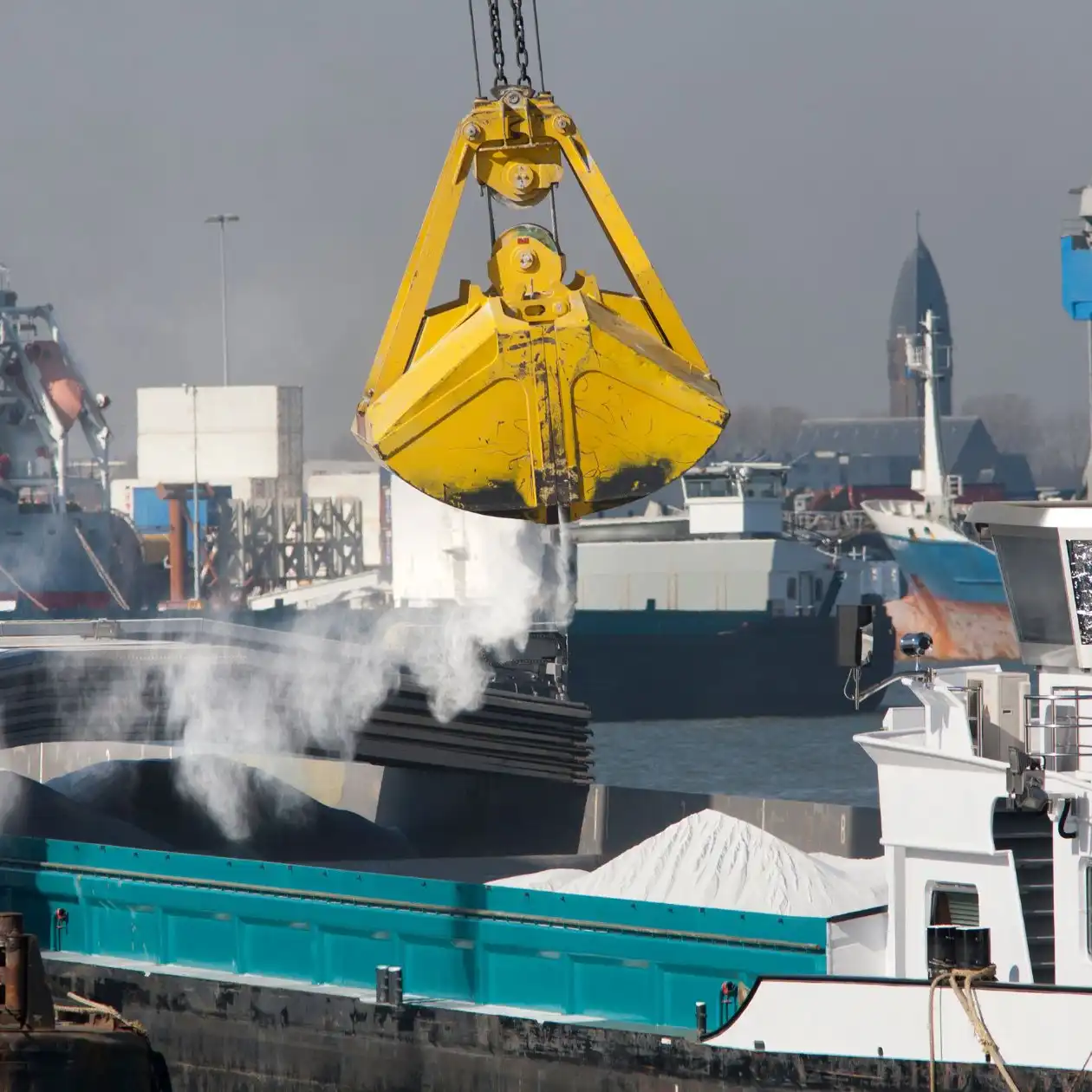
Voyage care is light. Holds are battened and unventilated; cement does not require temperature control or fumigation. The risk axis is water ingress through hatches, ventilators or bilge piping. Discharge is by grab at conventional ports (slow, dusty, complaint-prone) or by pneumatic equipment at cement-specific terminals (fast and metered). Rates vary from 1,500 tonnes per weather working day at low-spec ports up to 7,500 tonnes per day at pneumatic terminals. See laytime and demurrage for how rates translate into economics.
Major trade routes
Sea lanes mostly run from producer surplus regions to consumer deficit regions within the same hemisphere.
-
Intra-Mediterranean (Turkey and Egypt to Spain, Italy, North Africa, the Levant). The largest concentration of cement parcel activity globally. Handysize and Supramax on five to ten day round trips. Turkish exporters are the dominant suppliers.
-
Turkey and Mediterranean to West Africa and the US Gulf. Long-haul on Supramax and occasional Panamax. The US Gulf imports cement because domestic clinker capacity is below cement demand; West Africa imports because clinker grinding capacity is regional but cement demand outstrips it through construction cycles.
-
Intra-Asia (Vietnam, Thailand and Indonesia to the Philippines, Bangladesh and Sri Lanka). Vietnam is the largest cement and clinker exporter in Asia. Mostly Supramax and Handysize on five to ten day lanes. The Philippines and Bangladesh are the structural deficit markets.
-
North-West Europe to West Africa and the Caribbean. Smaller volumes from Germany, the Netherlands and Norway feeding cement and specialty cement to West African and Caribbean construction projects. Predominantly Handysize and specialist cement carrier tonnage.
-
Specialist self-discharging routes. Cement carriers operated by NovaAlgoma, Cargill and similar fleets run dedicated lanes for the majors. These do not appear in the conventional spot fixture record.
Trade-flow volumes shift cycle to cycle. Global Cement Magazine quarterly reports remain a canonical reference; broker desks cross-check those against routes and markets snapshots.
Cement vs clinker
The most common disambiguation request on the broker desk is cement versus clinker. They are sequentially related: clinker is the partly-finished kiln product, cement is the ground and blended end product. Operationally they are different cargoes with different risk profiles.
| Cement | Clinker | |
|---|---|---|
| IMSBC schedule | CEMENT | CEMENT CLINKER |
| IMSBC group | Group C | Group C |
| Stowage factor (m3/t) | 0.65 to 0.75 | 0.65 to 0.85 |
| Form | Fine grey powder, less than 75 microns | Hard granular nodules, 3 to 25 mm |
| Loading temperature | Ambient to about 60 deg C | 60 to 90 deg C when prompt off the kiln |
| Dust profile | Severe (fluid in hold) | Moderate (granular) |
| Hold cleanliness | Very high (food-grade-equivalent residue control) | Standard bulk |
| Abrasion on holds | Low | High (abrasive on hold steel) |
| Moisture risk | High (sets irreversibly) | Lower (granular tolerates contact) |
| Vessel preference | Handysize, Supramax, specialist cement carrier | Supramax, Handysize |
| Discharge complexity | Pneumatic or grab; dust complaints common | Grab and conveyor; abrasion to equipment |
In a chartering decision, clinker is the easier fixture: it does not need food-grade-equivalent residue control and tolerates imperfect hold preparation. Cement is harder because it pulls the next stem along with it on the cleaning bill. A broker quoting cement on a vessel that just lifted grain or sugar should expect the shipper to require an independent hold-pass survey and to load owner with the cleaning cost. The lateral cross-reference is scrap-metal, which is structurally incompatible with cement on the same vessel rotation.
Reference example
Supramax cement, Turkey to West Africa
- Cargo
- 50,000 mt bulk Portland cement, CEM I 42.5R
- Lane
- Iskenderun or Aliaga range to Lagos and Tema range
- Vessel
- Geared Supramax, 55,000 to 60,000 dwt
- Laycan
- 10 day window
- Loading rate
- 5,000 mt per weather working day SHEX
- Discharge rate
- 2,000 mt per weather working day SHEX
- Key clauses
- GENCON 2022 amended, independent hold-pass survey at load port, demurrage USD 18,000 per day pro rata, freight prepaid
The lane runs around 4,500 nautical miles one way. The hold-pass survey clause is the load-side risk axis: any prior carry-over from grain, salt or sugar will trigger a remediation hold at owner’s time, and the load port will not accept notice of readiness until the surveyor passes the holds. Most owners protect themselves by lifting clinker, iron ore concentrate or another non-staining cargo on the prior leg.
Discharge in West African ports is by ship’s gear with grabs, and the 2,000 mt per day discharge rate reflects the absence of pneumatic equipment at most receiver berths. Freight prepaid is standard because counterparty risk is non-trivial; the bill of lading is claused accordingly. Demurrage at USD 18,000 per day is set near the Supramax daily TCE for the relevant quarter. Anonymised fixture.
Common loading and discharge issues
- Prior-cargo carry-over on the hold-pass survey. The most frequent dispute on cement fixtures. Independent surveyors will fail a hold for residual grain dust under a hatch coaming or a salt film on tank-top steel. Remediation can take 24 to 72 hours and the notice of readiness is rejected for the duration.
- Pneumatic discharge equipment compatibility. Specialist cement carriers and cement-specific terminals use proprietary pneumatic systems. A vessel with the wrong fittings cannot discharge through terminal pipework and reverts to grab at a fraction of the rate, breaking the laytime calculation.
- Dust complaints at urban discharge ports. Cement dust is a regulated air-quality issue in most port jurisdictions. Discharge can be suspended on a single complaint; the charter-party laytime regime must specify whether such stoppages count as weather-related.
- Water ingress through hatches or ventilators in heavy weather. Any water reaching the cargo sets a hard cake at the contact zone. The claim is pursued against the owner’s P and I club under Hague-Visby; bilge alarms and weathertightness inspections are the controls.
- Mill-fresh hot cement on load. Cement direct from the mill can arrive above 60 deg C, accelerating condensation on cool hold sides. Producer despatch schedules should hold cement in mill silos for 24 hours before loading.
- Cargo quantity dispute on draught survey. Bulk cement is invoiced on draught survey. Air entrainment from the loading conveyor can show a 0.5 to 1.0 pct discrepancy that becomes a freight invoice dispute.
Scope and what this page does not cover
This page covers conventional bulk cement carriage on dry bulk tonnage. It does not cover bagged cement in containers, specialist cement carrier engineering, or Portland cement chemistry. For commercial structuring of a programme, work with the ship-brokering team against current Baltic Exchange data, and verify all IMSBC values against the live 2024 Code at the load port. To price a cement fixture, get a quote.